
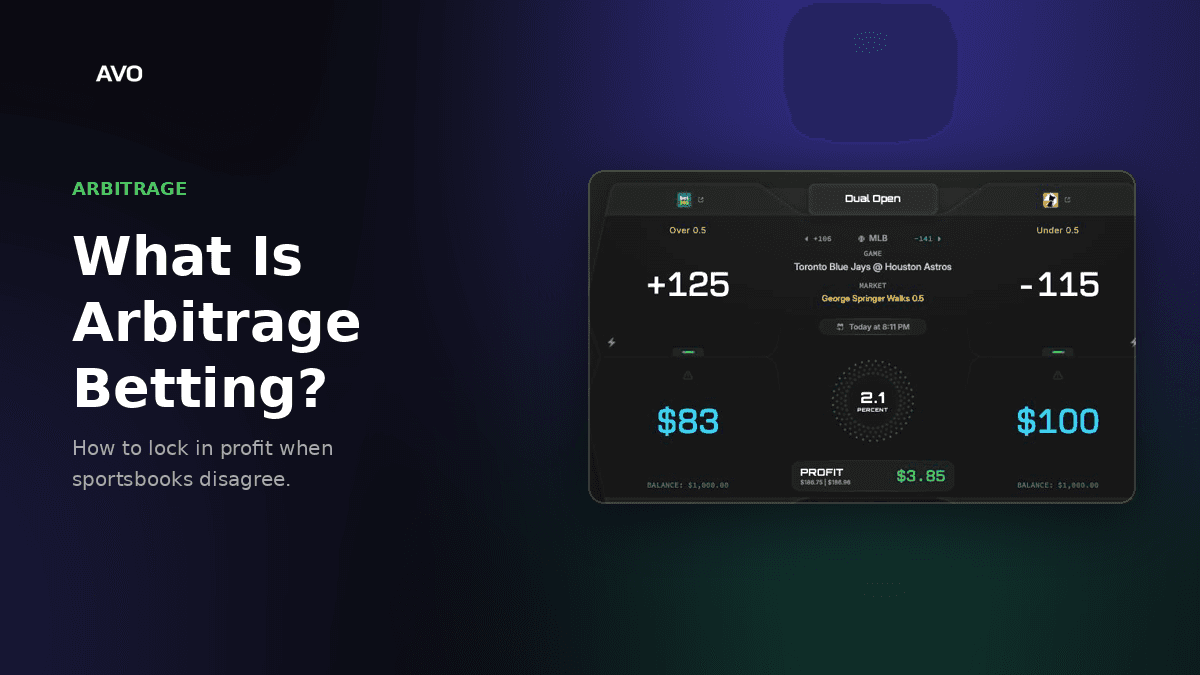
Sportsbooks don't agree with each other. One book's traders think a team is a slight favorite; another's think it's a coin flip. Most of the time those disagreements are small enough not to matter. Occasionally they're wide enough that you can bet every outcome and still come out ahead — and that's arbitrage betting.
Arbitrage betting means placing bets on all possible results of an event, at different sportsbooks, at prices where your total payout exceeds your total stake no matter who wins. It isn't prediction and it isn't handicapping. You don't need an opinion on the game. You need two books whose numbers disagree by enough, and the discipline to act before they don't.
This guide covers the math behind it, a full worked example, how to actually find arbs, and — just as importantly — the parts that trip people up.
How Arbitrage Betting Works
The whole thing rests on one idea: implied probability.
Every set of odds implies a probability. American odds of +150 imply about a 40% chance; -110 implies about 52.4%. If you add up the implied probabilities of every outcome at a single sportsbook, you'll always get more than 100% — that excess is the book's built-in margin, called the vig or juice. It's how the house makes money, and it's why you can't arbitrage within one book.
But when you shop each side at a different book, you're no longer stuck with one book's margin. If the best available price on each outcome, combined, implies less than 100%, an arbitrage exists. The gap below 100% is your profit margin.
That's the entire test:
- Sum of implied probabilities > 100% → no arb (normal state of affairs)
- Sum of implied probabilities < 100% → arb, and the shortfall is your edge
For a two-way market you can check it directly with decimal odds: if (1 ÷ odds A) + (1 ÷ odds B) comes to less than 1, you have an arb. The implied probability calculator does this conversion for you.
A Worked Example
Say a tennis match is priced like this across two books:
- Book A: Player 1 at +120 (decimal 2.20) → implied probability 45.5%
- Book B: Player 2 at -105 (decimal 1.952) → implied probability 51.2%
Add them: 45.5% + 51.2% = 96.7%. Under 100%, so this is an arb with roughly a 3.3% margin.
Now size the two bets so both outcomes return the same amount. With a $1,000 total stake:
| Outcome | Book | Odds (decimal) | Stake | Returns if it wins |
|---|---|---|---|---|
| Player 1 | Book A | 2.20 | $470.13 | $1,034.29 |
| Player 2 | Book B | 1.952 | $529.87 | $1,034.29 |
| Total | $1,000 | $1,034.29 either way |
Whoever wins, you collect about $1,034 on $1,000 staked — roughly $34, or 3.4%. That's a strong arb; most real ones land between 0.5% and 2%.
The stake split is where people lose money. Getting the odds comparison right but the stake sizing wrong turns a locked position into a directional bet. Run the numbers through an arbitrage calculator rather than estimating — the whole point is that the outcome shouldn't matter, and sloppy sizing gives that away.
How to Find Arbitrage Bets
There are two approaches, and the gap between them is large.
Manually means opening accounts at a dozen sportsbooks, picking a market, comparing every book's price on each side, converting to implied probabilities, checking whether they sum under 100%, then calculating stakes — and doing that repeatedly across hundreds of markets. It's genuinely possible, and it's how arbitrage worked for years. It's also slow enough that the best opportunities are gone before you've finished the arithmetic.
With software, a scanner watches every market at every book continuously and tells you the moment a combination goes under 100%. This is what changed the game: arbs typically live for seconds to a few minutes, and human comparison speed simply isn't competitive anymore.
The practical prerequisites either way:
- Accounts at multiple sportsbooks, funded simultaneously. You can't move money between books fast enough to chase an arb. Which ones to open is its own question — we work through it in best sportsbooks for arbitrage betting.
- Enough bankroll to split across both legs at once.
- Speed of execution. Both bets need to land before either line moves.
- A calculator you trust for the stake split.
What Eats Your Margin
Arbitrage margins are thin, so the details decide whether you actually profit:
- Line movement mid-execution. You place leg one, the price on leg two moves, and your 2% arb becomes 0.3% — or disappears. The most common way arbs fail.
- Bet limits. A book may only accept a fraction of the stake your calculation assumed, leaving you underweight on one side.
- Bonus and promo restrictions. Bets placed with bonus funds often have terms that break the arithmetic.
- Withdrawal friction and fees. Profit that's stuck or shaved isn't fully profit.
- Rounding. Betting $85 instead of $83.47 costs you a bit of edge (though it helps you look recreational — see below).
- Voided or graded-differently bets. If one book voids a leg and the other doesn't, you're exposed.
None of these are exotic. They're the normal texture of arbitrage, and planning for them is most of the skill.
Is Arbitrage Betting Legal?
Yes — arbitrage betting is legal in every US state with legal sports betting, and no state criminalizes it. The real constraint is that sportsbook terms of service permit books to limit or close accounts at their discretion, and consistent arbitrage activity commonly leads there. That's a business risk, not a legal one. We cover the distinction, how books detect arbitrage, and how to extend account life in is arbitrage betting legal.
Arbitrage Beyond Sportsbooks
The same math works anywhere two markets price the same event differently. That's not a betting invention — arbitrage is a long-established practice in financial markets, where traders exploit price differences for the same asset across exchanges. Betting markets are simply less efficient than equities, which is why the gaps are bigger and last longer.
Increasingly, the widest gaps aren't between two sportsbooks at all.
Prediction markets like Kalshi and Polymarket price outcomes as binary contracts traded by a completely different crowd than sportsbooks serve. Two different crowds pricing the same game produce bigger disagreements than two sportsbooks do. If that's interesting, start with Kalshi arbitrage betting for prediction-market-versus-sportsbook setups, or prediction market arbitrage for Kalshi-versus-Polymarket.
There's also a close cousin worth knowing: instead of covering every outcome for a certain return, you can take only the side that's mispriced and accept variance for a higher long-run edge. That's positive EV betting — same underlying idea about finding bad prices, different risk profile.
Finding Arbs Without the Grind
Every step above — monitoring books, converting odds, testing the sum, sizing both legs — is mechanical. Software does it faster and doesn't make arithmetic mistakes.
AVO's arbitrage betting tool scans odds across 70+ sportsbooks in real time, flags every combination where implied probabilities fall under 100%, and calculates the exact stake for each side so the payouts match. It was built by former arbitrage bettors who got tired of losing opportunities to the time it takes to do the math — which is why it's designed around speed of execution rather than just data.
Try AVO's arbitrage tool free →
The right frame for arbitrage betting isn't gambling. It's spotting a pricing inconsistency between two markets and acting on it before it corrects — closer to how a trading desk thinks than a bettor.
Frequently Asked Questions
What is arbitrage betting in simple terms? Betting on every possible outcome of an event at different sportsbooks, at prices good enough that your total return beats your total stake regardless of the result.
How do you arbitrage a bet? Find a market where the best price on each outcome, combined, implies under 100% probability. Then split your stake between the books so each outcome pays the same amount, and place both bets quickly.
Is arbitrage betting risk-free? The outcome risk is removed once both legs are placed, but practical risks remain: lines moving mid-execution, bet limits, voided bets, and account limits. Low-variance is more accurate than risk-free.
How much can you make arbitrage betting? Typical arbs run 0.5–2% per opportunity, so returns depend on bankroll, how many opportunities you catch, and how long your accounts last — not on any single bet.
Do I need a lot of money to start? You need enough to fund multiple sportsbook accounts at once and split stakes across both legs. Small bankrolls work, but absolute profit scales with capital since the percentage edge is fixed.
Will I get banned for arbitrage betting? Possibly. It's not illegal, but sportsbooks may limit or close accounts they identify as arbitraging. See our legality guide for how detection works and how to reduce the risk.
AVO is an analytics platform for adults — not a sportsbook. AVO does not accept wagers or hold funds. Must be of legal age (21+). Please bet responsibly.

