
If you've spent any time around serious bettors, you've seen "EV" thrown around constantly — +EV, -EV, "that's an EV play." So: what does EV mean in betting?
EV stands for expected value: the average amount a bet would win or lose if you could place that exact bet thousands of times. It's a single number that answers the only question that matters long-term — was the price you got better or worse than the true odds?
Here's the mental shift that makes EV click. Winning a bet doesn't mean it was a good bet, and losing one doesn't mean it was bad. A coin flip paying 3-to-1 is a fantastic bet even when it loses. EV separates the quality of your decision from the luck of the outcome, and that's why it's the metric sharp bettors actually track.
What EV Means in Practice
Every bet has two prices: the one the sportsbook offers you, and the one that reflects the real chance of the thing happening. EV measures the gap.
- Positive EV (+EV) — the sportsbook's price is better than the true odds. You're getting paid more than the risk deserves. Over enough bets, you profit.
- Negative EV (-EV) — the price is worse than the true odds. Over enough bets, you lose. Most bets available at a sportsbook are -EV by design; that's how the house makes money.
The word "expected" is doing a lot of work there. A +EV bet is not a bet you expect to win — plenty of +EV bets are underdogs that lose most of the time. It's a bet you expect to profit from on average, which is a different claim entirely.
How to Calculate EV
The formula is straightforward:
EV = (Win Probability × Profit if Won) − (Loss Probability × Amount Staked)
Let's run a real one. You're looking at a bet at +150 odds (risk $100 to win $150), and you believe the true chance of it hitting is 45%.
| Input | Value |
|---|---|
| Odds | +150 |
| Your estimated win probability | 45% |
| Implied probability from odds | 40% |
| Stake | $100 |
- If it wins (45% of the time): you profit $150
- If it loses (55% of the time): you lose $100
EV = (0.45 × $150) − (0.55 × $100) = $67.50 − $55.00 = +$12.50
That bet is worth +$12.50 per $100 wagered — a 12.5% edge. Note what happened: the odds implied a 40% chance, you assessed 45%, and that 5-point gap is the entire edge. You can run any bet through the free expected value calculator rather than doing this by hand.
The hard part isn't the formula — it's the probability. Calculating EV takes ten seconds once you know the true win probability. Estimating that probability accurately is the actual skill, and it's where nearly all the work lives.
Where the "True" Probability Comes From
If EV depends on knowing the real odds, how does anyone know them?
The practical answer is that you don't compute them from scratch — you derive them from the market. Sportsbook odds include a built-in margin called the vig (or juice), which inflates the implied probabilities so they add up to more than 100%. Strip the vig out and you get a much better estimate of the true odds. That's called devigging, and the sharpest books' devigged lines are the closest thing to a fair price the market produces.
That gives you a workable process: take a sharp book's price as your probability estimate, then compare it against the price a softer book is offering. When the soft book's number is meaningfully worse than the sharp consensus, you've found a +EV bet. The implied probability calculator handles the odds-to-percentage conversion, and the no-vig calculator removes the margin.
Reading EV Numbers
You'll see EV expressed a few different ways:
- EV in dollars — "+$12.50" on a $100 bet. Concrete, but depends on stake size.
- EV percentage — "+12.5%." Stake-independent, which makes it the standard way to compare bets against each other.
- Edge — the gap between your estimated probability and the implied probability (45% vs 40% = a 5% edge).
For context on what's realistic: a consistent 1–3% edge is genuinely good in liquid betting markets. Anything advertised as a 20% edge is usually either a stale line that's about to move, a mistake in your probability estimate, or a market so thin you can't get real money down.
Why EV Matters More Than Your Win Rate
Two bettors can both go 50-50 and end the year in completely different places. The one who consistently took +EV prices makes money; the one who took -EV prices loses it. Win rate tells you nothing on its own — it's the prices you took that determine the outcome.
None of this is unique to betting. Expected value is a standard concept in statistics and finance, used to price everything from insurance policies to options contracts. Betting is just one more market where the discipline of comparing price against true probability decides who profits.
This is also why EV requires patience to be meaningful. Expected value is an average across many bets, so short-run results say almost nothing about whether you're betting well. Variance dominates over dozens of bets; EV dominates over thousands. Judging your process by last weekend's results is the most common way bettors talk themselves out of a winning approach.
Finding +EV Bets Without Doing the Math Yourself
Everything above is mechanical: pull the sharp line, devig it, compare against every other book, compute the edge, size the bet. It's exactly the kind of repetitive work software should handle.
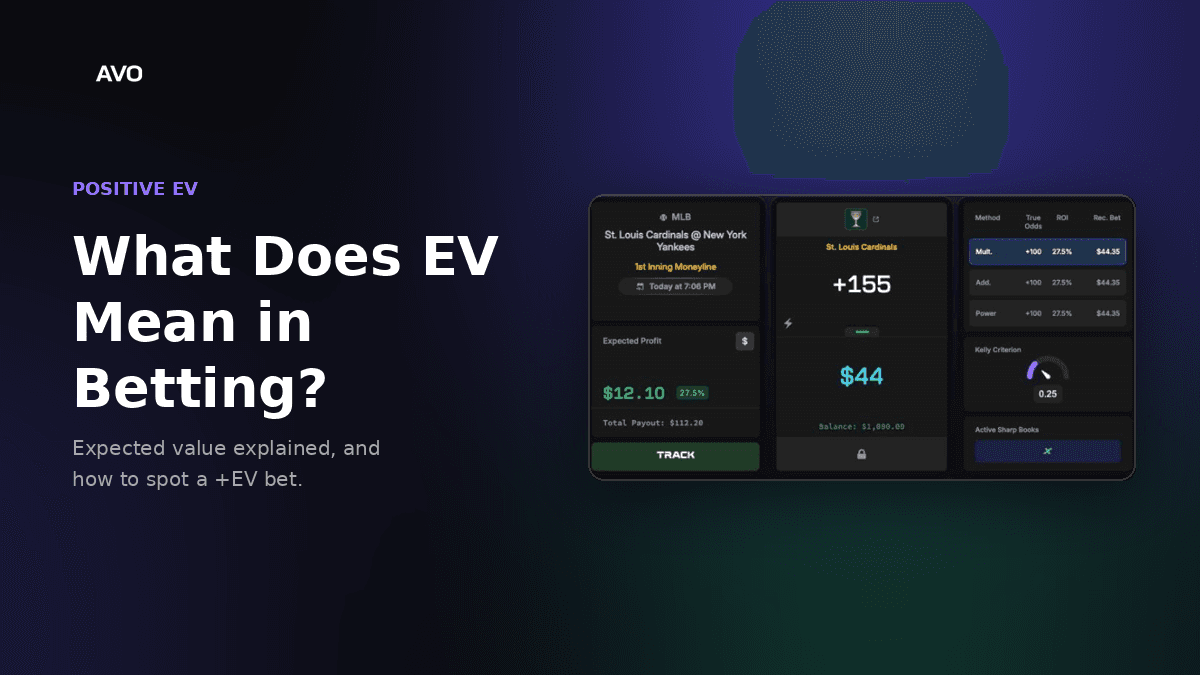
That's what AVO's positive EV betting tool does — it scans odds across 70+ sportsbooks in real time, devigs sharp lines to estimate true probability, and surfaces bets where a book's price is out of line with the market, with the EV percentage and a recommended stake already calculated. You get the output of the process without running it by hand.
Either way you'll want accounts at several books, since a +EV price only exists where one book disagrees with the field. Which sportsbooks to open walks through building that set.
If you'd rather remove outcome risk entirely instead of grinding an edge over time, the related approach is arbitrage betting — covering every result so the outcome doesn't matter. EV betting has a higher ceiling; arbitrage has lower variance. Plenty of bettors run both.
Frequently Asked Questions
What does EV mean in betting? EV means expected value — the average profit or loss a bet produces over the long run, based on the odds you got and the true probability of the outcome.
What is a +EV bet? One where the sportsbook's price is better than the true odds, so it profits on average over many placements. Individual +EV bets lose all the time.
Is EV betting profitable? It can be, but it requires volume, accurate probability estimates, and patience — the edge per bet is small (often 1–3%) and only shows up across hundreds or thousands of bets.
What's the difference between EV and arbitrage? EV betting takes an edge on one side and accepts variance. Arbitrage covers every outcome for a smaller, more certain return. EV has more upside; arbitrage has less swing.
Do I need to calculate EV manually? No. The formula is simple but the inputs are the work. Tools that devig sharp lines and compare books do the whole process automatically.
AVO is an analytics platform for adults — not a sportsbook. AVO does not accept wagers or hold funds. Must be of legal age (21+). Please bet responsibly.

