
Sooner or later, almost every winning bettor opens a sportsbook app and finds their maximum bet has dropped to $14. No email, no warning, just a smaller number than yesterday. That's a limit, and if you bet arbitrage, positive EV or promos seriously, it's the single biggest constraint on how much you can make.
You can't make an account last forever. But you can make it last a lot longer, and you can plan so that no single limit changes what you're able to do tomorrow. This guide covers what sportsbooks look for, the habits that extend account life, whether you can actually get banned for arbitrage betting, and exactly what to do when it happens.
The short version: sportsbooks limit accounts that look like they're winning on purpose: consistently beating the closing line, betting odd amounts, hitting stale prices and only showing up for edges. To last longer, round your stakes, stay below the maximum, mix in normal-looking activity on main markets, avoid obvious pricing errors and keep deposits and withdrawals boring. Most importantly, spread your volume across many books and anchor it with exchanges and prediction markets, which have no reason to limit winners.
What "Getting Limited" Actually Means
Limits come in a few forms, from mild to severe:
| Type of limit | What it looks like |
|---|---|
| Stake limits | Your maximum bet drops, often to a small fraction of what other users can place. The most common form. |
| Market restrictions | Certain sports, props or live markets stop accepting your bets, or cap you far lower than main lines. |
| Promo exclusion | You stop receiving boosts, bonus bets and deposit offers. |
| Delays and manual review | Your bets go to a trader for approval, and the price often moves before they're accepted. |
| Account closure | Rare at licensed US books, but it happens. Your balance is returned and the account is closed. |
A limited account isn't necessarily useless. Many still accept reasonable bets on main lines, and they can still work as the smaller leg of an arb.
Why Sportsbooks Limit Winning Bettors
A sportsbook isn't a neutral marketplace. It's a business that sets prices and takes the other side of your bet. Its model depends on most customers losing over time to the margin built into the odds.
A bettor who consistently gets better prices than the market, whether through arbitrage, +EV betting or promo conversion, is a customer the book expects to lose money on. Limiting that customer is ordinary risk management from the book's point of view. It's not personal, and it doesn't mean you did anything wrong.
The exception that proves the rule: exchanges and prediction markets. Platforms like Novig, ProphetX, Sporttrade, Kalshi and Polymarket match bettors against each other and earn a commission or fee rather than profiting from your losses. They have no structural reason to limit winners, which is why they matter so much for anyone betting seriously.
What Sportsbooks Look For
No book publishes its exact criteria, and every operator weighs signals differently. But the patterns that draw attention are consistent across the industry.
| Signal | Why it stands out |
|---|---|
| Beating the closing line | The single strongest sign of a sharp bettor. If your prices are routinely better than where the line closes, the book knows you're getting value. |
| Odd, precise stakes | Bets like $83.47 look calculated by software. Recreational bettors bet round numbers. |
| Betting only stale or off-market prices | If you only ever bet the one line that's out of step with every other book, the pattern is obvious. |
| Niche markets at size | Large bets on low-limit markets like lower-league props are where books are most exposed and most watchful. |
| Betting the max every time | Maxing out every bet you place signals you know something. |
| Timing | Betting the instant a line is posted, or seconds before it moves, looks like reacting to information. |
| Promo-only activity | Accounts that appear for boosts and bonus bets and nothing else get flagged quickly. |
| Fast deposit-to-withdrawal cycles | Depositing, claiming an offer and withdrawing soon after is a classic promo-abuse pattern. |
Arbitrage bettors tend to hit several of these at once, which is why arb accounts often get limited faster than +EV accounts.
Can You Get Banned for Arbitrage Betting?
Not by the law. Arbitrage betting is legal in every US state with legal sports betting. You're taking prices that sportsbooks are publicly offering. Our guide to whether arbitrage betting is legal covers the legal side in full.
But sportsbooks can and do restrict accounts for it. Their terms of service give them broad discretion to limit stakes or close accounts, and arbitrage is one of the most common reasons they use it.
What's changed is that bettors no longer have to guess. Since June 2026, Massachusetts requires licensed sportsbooks to notify a bettor within 48 hours of limiting them and give a specific, individual reason, with boilerplate language not accepted. Bettors posting their notices online have seen books cite things like wagering patterns and timing-based market concerns, and some books have named arbitrage directly. The Massachusetts rule is covered in detail by Sportsbook Review.
Other states are looking at the same idea. In New Jersey, bill A4002, which would require books to notify and explain limits and to periodically review limited accounts, cleared an Assembly committee in May 2026.
So the honest answer: you won't get in legal trouble for arbing, but you should expect sportsbooks to restrict you eventually, and plan for it.
Habits That Keep Your Accounts Open Longer
None of these will make an account last forever. Together, they can stretch its life considerably. Each one costs a little edge, so treat them as trade-offs, not rules.
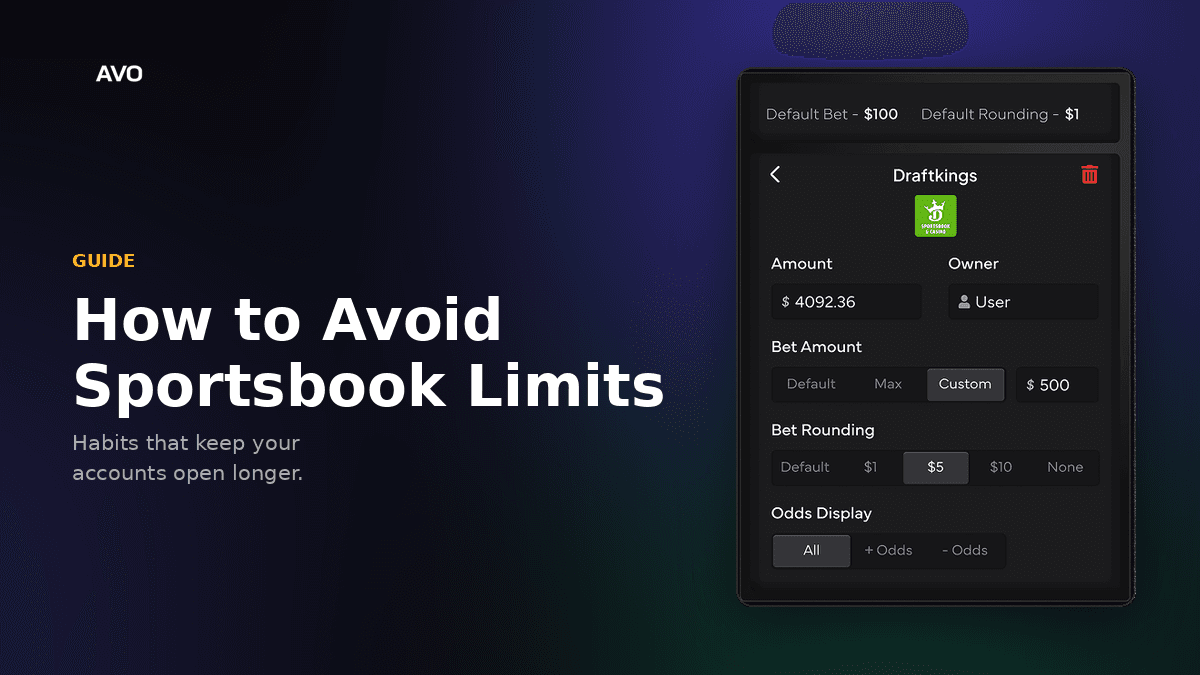
1. Round your stakes. Bet $85, not $83.47. This removes the most obvious software signal for a few cents of edge. AVO lets you set bet rounding per sportsbook ($1, $5 or $10), so recommended stakes come out as round numbers automatically.
2. Stay below the maximum. Don't max out every bet. A book that sees you consistently betting its ceiling learns quickly what you are.
3. Favor main markets for size. Moneylines, spreads and totals on major leagues have high limits and get less scrutiny. Save smaller stakes for props and niche markets.
4. Skip the tiniest and the biggest edges. A 0.5% arb isn't worth the account exposure. A 20% "arb" is usually an obvious pricing error that may get voided and will definitely get noticed.
5. Don't sprint at every line. Betting the moment a price appears, every time, is a pattern. Being a little slower on some bets is often worth the longevity.
6. Keep deposits and withdrawals boring. Avoid withdrawing right after claiming a sign-up offer. Leave a working balance in the account and withdraw in larger, less frequent amounts.
7. Use the app like a normal customer. Log in, look around, bet some ordinary games. An account that only ever opens to place a single sharp bet looks different from one that's used.
8. Mix in normal-looking activity, carefully. Some bettors place small recreational bets to make their account look less one-dimensional. This costs real money in expectation, so keep it small and deliberate, and favor low-margin markets when you do it. The hold calculator shows how much margin a market carries.
9. Take the promos. Boosts and bonus bets are recreational behavior. Using them, and converting them sensibly, reads as normal and adds value.
10. Spread volume across many books. The less of your action any one book sees, the slower it builds a picture of you. This is the most effective habit on the list.
What Not to Do
Some "tricks" for avoiding limits cross from smart into prohibited, and the consequences are far worse than a limit.
- Don't open multiple accounts at the same book, or use accounts in a friend's or family member's name. It violates every sportsbook's terms, can lead to confiscated winnings, and may be treated as fraud.
- Don't spoof your location with VPNs or similar tools. Geolocation is a legal requirement for licensed books, and getting around it puts both your account and your balance at risk.
- Don't argue with or mislead the sportsbook about your betting. If you're limited, accept it, withdraw what you want and move on.
Staying on the right side of these lines is what lets you keep using legal, regulated books at all.
What to Do When You Get Limited
It will happen. Here's how to handle it well.
- Check why, if you can. If you're in Massachusetts, the book must tell you why within 48 hours. Elsewhere, you can still ask support, though answers are often generic.
- Keep the account if it's still useful. A limited account may still accept full-size bets on main lines, still give you promos, or work fine as the smaller leg of an arb.
- Move your money. Withdraw what you don't need there. If you'd rather move funds into another book without a withdrawal wait, AVO's $Mover tool finds low-hold bets that shift a balance from one book to another while giving up very little.
- Open the next account on your list. Treat limits as a normal cost of doing business. Our guide to the best sportsbooks for arbitrage betting covers which books to add and how to split your bankroll across them.
- Lean on exchanges and prediction markets. Make them the leg you use most often, so your volume doesn't depend on any one sportsbook.
Plan for a Portfolio, Not a Single Account
The bettors who last aren't the ones who avoid limits entirely. They're the ones whose setup doesn't break when a limit arrives.
That means holding several mainstream books for volume, at least one low-vig exchange as a leg that won't be limited, and a prediction market for the widest price gaps and for states where sportsbooks aren't available. When one account gets restricted, the rest of the portfolio keeps working.
It also helps to think about the order in which you use an account. Many bettors start a new book with sign-up promos, which look recreational and build a bankroll, then move on to +EV and arbitrage once the account has some history.
Our guides to positive EV betting and arbitrage betting cover each strategy in depth.
How AVO Helps Your Accounts Last
AVO is built by former arbitrage bettors, so the tools account for limits rather than ignoring them:
- Bet rounding per book, so stakes come out as round numbers instead of software-precise amounts.
- Custom bet amounts and max settings per sportsbook, so you can keep stakes below a book's ceiling or match a limited account's new maximum.
- Coverage across 70+ sportsbooks, exchanges and prediction markets, so your volume can be spread widely and anchored on venues that don't limit winners.
- The $Mover to rebalance funds between books without waiting on withdrawals.
- AVO Tabs, which opens both books at once so you can place both legs of an arb before the price moves.
Find arbitrage bets across your books with AVO →
Frequently Asked Questions
Why did my sportsbook limit me? Usually because your betting looks profitable on purpose: beating the closing line, betting stale prices, odd stake sizes or only betting promos and edges. Sportsbooks limit customers they expect to lose money on.
Can you get banned for arbitrage betting? Not legally, since arbitrage betting is legal. But sportsbooks can limit or close accounts under their terms of service, and arbitrage is a common reason. Massachusetts now requires books to tell bettors why they were limited.
How long does it take to get limited by a sportsbook? It varies widely by book, strategy and stake size, from a few weeks to many months. Timelines you see online are estimates, and no sportsbook publishes its criteria.
Do sportsbooks limit winners? Most mainstream sportsbooks do eventually limit consistent winners. Betting exchanges and prediction markets generally don't, because they earn fees or commission rather than profiting when you lose.
Can a limited sportsbook account be unlimited? Occasionally, after a period of normal activity, or on request. New Jersey's proposed A4002 would require books to review limited accounts periodically, but there's no general right to have a limit removed today.
Will a sportsbook refuse to pay my winnings if I arb? Rarely at licensed US operators. Legitimate bets at posted odds are paid; the usual consequence is a limit afterward. Bets on obvious pricing errors are the exception, as books can void those under their rules.
AVO is an entertainment tool for adults and an analytics platform, not a sportsbook. AVO does not accept wagers and does not hold funds. You must be of legal age to bet in your jurisdiction (21+ in most states). Sportsbook terms and state regulations change frequently; check each operator's current terms. Please bet responsibly.

