
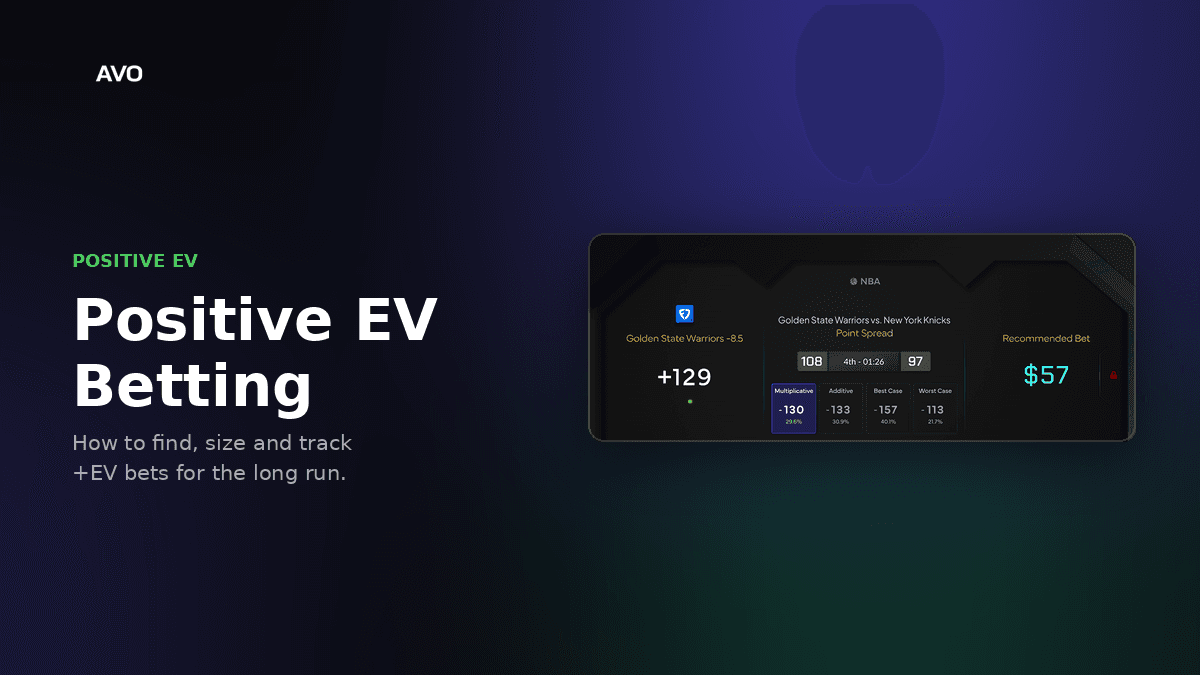
Positive EV betting is the closest thing sports betting has to a real, repeatable edge. The idea is simple: only bet when the price you're offered is better than the true odds of the outcome. Do that consistently and the math works in your favor over time.
The hard part isn't the idea. It's everything around it: finding those prices fast enough, sizing bets so a bad week doesn't wipe you out, sticking with it through long losing stretches, and knowing whether you're actually doing it right. That's what this guide covers.
If you're new to the term itself, start with what EV means in betting, which explains expected value from the ground up. This article picks up where that one leaves off.
The short version: +EV betting works by comparing a soft sportsbook's price against a sharp, devigged estimate of the true odds, and betting only when the soft price is better. Size each bet as a small fraction of your bankroll (most bettors use a quarter to a half of the Kelly criterion), expect long losing runs even when you're betting well, and judge yourself by closing line value rather than short-term results.
How Positive EV Betting Works in Practice
Every sportsbook builds a margin into its prices. But not every book prices games equally well. Some books, and especially exchanges where bettors trade against each other, have very efficient prices because sharp money moves them quickly. Others are slower to react, set lines for recreational bettors, or simply disagree with the market.
Positive EV betting uses that gap:
- Find a sharp price. Take the odds from the most efficient markets, like low-vig exchanges or the sharpest US books.
- Remove the margin. Strip out the vig to estimate the true probability of each outcome. This is called devigging.
- Compare against every other book. When a softer book offers a better price than that true probability justifies, the bet is +EV.
- Bet it, and repeat thousands of times. Any single +EV bet can lose. The edge only shows up in aggregate.
Unlike arbitrage betting, where you bet every side of a market to lock in a return, +EV betting takes one side and accepts the variance. That's why its long-run ceiling is higher, and why it takes more patience.
Finding +EV Bets: Devigging Explained
Devigging is the step that turns raw odds into a fair-price estimate, and there's more than one way to do it.
Say a sharp market prices a game at -110 on both sides. Each side implies 52.4%, adding up to 104.8%. The extra 4.8% is the margin. Remove it and each side is 50%, or fair odds of +100.
The three common devig methods handle that margin slightly differently:
| Method | How it removes the vig | When it's most used |
|---|---|---|
| Multiplicative | Scales each side's probability down proportionally | The default for most two-way markets |
| Additive | Subtracts an equal share of the margin from each side | Simple and close to multiplicative on balanced lines |
| Power | Adjusts for books loading more margin onto long shots | Markets with a heavy favorite and a big underdog |
You don't need to pick one forever. On balanced lines they agree closely; on lopsided ones the power method is often more realistic. The no-vig fair odds calculator lets you try them side by side, and AVO's positive EV tool shows the fair price under several methods for every bet it surfaces.
A Worked Example
The sharp, devigged price on a game says a team has a 50% chance to win, fair odds of +100. One sportsbook is offering that team at +115.
- If you bet $100 and win (50% of the time), you profit $115.
- If you lose (50% of the time), you lose $100.
EV = (0.50 × $115) − (0.50 × $100) = +$7.50, or a 7.5% edge.
You'll lose this exact bet half the time. But placed over and over at that price, it averages $7.50 profit per $100 wagered. The expected value calculator runs this for any odds and probability.
For context, a consistent 1% to 3% edge is very good in liquid markets. Larger numbers like the one above do appear, but treat them with suspicion until you've ruled out a stale line or a mistake.
How Much to Bet: Kelly and Bankroll Management
Finding +EV bets is half the job. The other half is sizing them so you survive long enough for the edge to play out.
The standard tool is the Kelly criterion, a formula that tells you what fraction of your bankroll maximizes long-run growth given your edge:
Kelly fraction = (b × p − q) ÷ b
Here b is your profit per $1 staked (decimal odds minus 1), p is your estimated win probability and q is 1 − p.
For the +115 example: b = 1.15, p = 0.50, q = 0.50. (1.15 × 0.50 − 0.50) ÷ 1.15 = 6.5% of bankroll.
That's "full Kelly," and almost no experienced bettor uses it. Full Kelly assumes your probability estimate is perfect, which it never is, and it produces brutal swings. Most +EV bettors bet a quarter to a half Kelly: here, roughly 1.6% to 3.3% of bankroll. You give up a little growth for a much smoother ride and far less risk of ruin.
| Kelly fraction | Stake on a $5,000 bankroll | Trade-off |
|---|---|---|
| Full Kelly (6.5%) | $326 | Maximum growth if your edge estimate is exact, very large swings |
| Half Kelly (3.3%) | $163 | About three-quarters of the growth, far less volatility |
| Quarter Kelly (1.6%) | $82 | Slower growth, very low risk of ruin |
Our Kelly criterion calculator does the math for any bet, and AVO's +EV tool shows a recommended stake using your chosen Kelly setting.
Variance: Why You Can Bet Well and Still Lose
This is the part that makes most people quit too early.
Imagine you place even-money bets with a genuine 3% edge, one unit each. Here's how likely you are to be down after a given number of bets, even though every bet was +EV:
| Bets placed | Expected profit | Chance you're still down |
|---|---|---|
| 100 | +3 units | ~38% |
| 250 | +7.5 units | ~32% |
| 500 | +15 units | ~25% |
| 1,000 | +30 units | ~17% |
| 2,500 | +75 units | ~7% |
| 5,000 | +150 units | ~2% |
After 100 well-placed bets, you have better than a one-in-three chance of being in the red. It takes thousands of bets before results reliably reflect your edge. That's not a flaw in the strategy. It's what "expected" means.
Two practical takeaways. First, bet sizes small enough that a losing stretch of several hundred bets doesn't end your run. Second, don't judge your process by your bankroll over a few weeks. Judge it by the next section.
Closing Line Value: How to Know You're Doing It Right
If short-term results are mostly noise, how do you know whether you're actually finding edges? Closing line value (CLV).
The closing line is the final price before a game starts, after all the information and sharp money has come in. It's the market's best estimate of the true odds. If you consistently bet at prices better than the closing line, you are, by definition, consistently getting good prices.
For example, you bet a team at +115 and it closes at +100. You beat the close by 15 cents of American odds. Do that across hundreds of bets and you can be confident your process works, long before your profit and loss shows it.
Tracking CLV is the single best habit a +EV bettor can build. AVO's bet tracking records every bet you place, so you can review your results by strategy, sport and sportsbook over time.
Common +EV Betting Mistakes
- Chasing the biggest EV numbers. A 25% edge is usually a stale line about to move or an obvious pricing error that may get voided. Steady 1% to 5% edges are the real business.
- Betting too big. Full Kelly or flat bets that are too large for your bankroll turn normal variance into a blown account.
- Trusting a soft book as your fair price. Your devig is only as good as the market you start from. Anchor to efficient prices.
- Results-based thinking. Changing your approach after a bad week is how good processes get abandoned.
- Ignoring account health. Consistent +EV betting is exactly what sportsbooks look for when they limit accounts. Our guide on how to avoid getting limited by sportsbooks covers how to make your accounts last.
- Too few books. A +EV price only exists where one book disagrees with the field. More accounts means more opportunities. See which sportsbooks to open.
Positive EV vs Arbitrage: Which Should You Run?
Most serious bettors end up doing both. They're built for different goals.
| Positive EV betting | Arbitrage betting | |
|---|---|---|
| What you bet | One side of a mispriced market | Every side, across different books |
| Outcome risk | Yes, individual bets lose | Removed once both legs are placed |
| Typical edge per bet | 1% to 5% | 0.5% to 3% |
| Variance | High, needs thousands of bets | Low |
| Bankroll needed | Can start smaller | Needs money spread across books |
| Long-run ceiling | Higher | Lower, but steadier |
A common path: build a bankroll with promos and arbitrage where results are steady, then add +EV volume as your bankroll grows and you get comfortable with variance.
How AVO Finds +EV Bets
Everything above is mechanical: pull the sharp prices, devig them, compare against every book, compute the edge, size the bet. Done by hand, the price is usually gone by the time you finish.
AVO's positive EV betting tool does it in real time across 70+ sportsbooks, exchanges and prediction markets. Each opportunity shows the true odds under several devig methods, the ROI, and a Kelly-based recommended bet, with an option to anchor to a sharp price of your choice. Then you place it, and AVO tracks the result.
Frequently Asked Questions
What is positive EV betting? Betting only when a sportsbook's price is better than the true probability of the outcome, so each bet is profitable on average over many placements even though individual bets lose.
Is positive EV betting profitable? Over a large enough sample, yes, if your edges are real and your bet sizing is sound. Short-term results are dominated by variance, so it can take thousands of bets for profit to reliably show.
How do you find positive EV bets? Devig the odds from an efficient, sharp market to estimate the true probability, then compare that against prices at softer sportsbooks. Software like AVO does this automatically across many books.
How much should I bet on a +EV bet? Most bettors use a quarter to a half of the Kelly criterion, which typically works out to around 1% to 3% of bankroll per bet.
What is a good EV percentage? A consistent 1% to 3% edge is very good in liquid markets. Much larger numbers are often stale lines or pricing errors.
What's the difference between EV and CLV? EV is the edge you estimate when you place a bet. CLV (closing line value) measures whether the price you got beat the final market price, which is the best evidence that your EV estimates are right.
AVO is an entertainment tool for adults and an analytics platform, not a sportsbook. AVO does not accept wagers and does not hold funds. You must be of legal age to bet in your jurisdiction (21+ in most states). Positive EV betting involves real risk of loss, and past results do not predict future outcomes. Please bet responsibly.

