
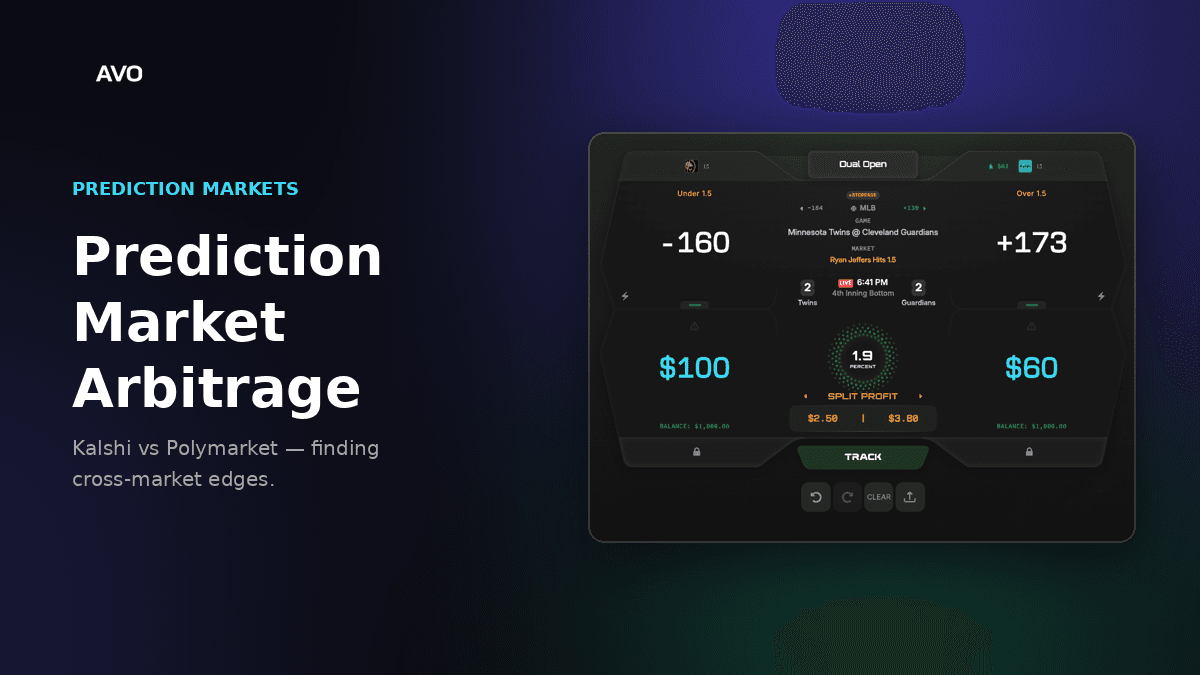
Two prediction markets can look at the same event and disagree on what it's worth. Kalshi says a team has a 55% shot; Polymarket says 60%. That disagreement is the entire opportunity behind prediction market arbitrage — and with prediction markets pushing tens of billions in volume through 2026, those disagreements are showing up more often, not less.
Prediction market arbitrage means buying the "Yes" side on the platform where it's cheap and the "No" side on the platform where it's cheap, so the two positions together cost less than $1.00. Since exactly one of them settles at $1.00, the difference is your margin. This guide covers the math, why the gaps open up, what fees do to a thin edge, and how to find these setups before they close.
A quick distinction. This article is about arbitrage between two prediction markets — Kalshi vs Polymarket. If you want to arbitrage a prediction market against a traditional sportsbook instead, that's a different setup with different (usually wider) gaps, and we cover it in Kalshi arbitrage betting. If the underlying concept is new to you, what is arbitrage betting covers the fundamentals first.
How Prediction Market Arbitrage Works
Prediction markets trade in binary contracts. Each one settles at $1.00 if the event happens and $0.00 if it doesn't, so the price is the implied probability — a contract at 55¢ means the market thinks there's a 55% chance.
That makes the arbitrage test simple. Buy "Yes" on one platform and "No" on the other, add the two prices, and if the total is under $1.00, you have an arb. Whatever happens, one contract pays $1.00, and your profit is the gap.
Two flavors show up in practice:
- Cross-platform arbitrage — the same event priced differently on Kalshi and Polymarket. This is the common one.
- Multi-outcome arbitrage — a single platform where every outcome in a market adds up to more or less than $1.00, which is a logical inconsistency you can trade against.
A Worked Example
Say both platforms list the same game, and the pricing looks like this:
- Polymarket: "Yes" is trading at 42¢
- Kalshi: "No" on the same outcome is trading at 55¢
| Leg | Platform | Price | Settles at |
|---|---|---|---|
| Yes | Polymarket | $0.42 | $1.00 if it happens |
| No | Kalshi | $0.55 | $1.00 if it doesn't |
| Total cost | $0.97 | $1.00 either way |
You've paid 97¢ for a position that returns $1.00 no matter which way it goes — a 3¢ gross margin, about 3.1%. Scale that to 1,000 contracts and it's roughly $30 on $970 committed.
Fees Are the Whole Game
A 3¢ gross edge sounds comfortable until fees land on it. This is where most prediction market arbitrage guides stop being useful.
Kalshi charges a per-contract trading fee that scales with price — roughly 0.07 × price × (1 − price), which peaks on contracts near 50¢ and is smallest on cheap or near-certain contracts. Polymarket's fee structure differs and has historically been lighter on trades, heavier on net winnings depending on which version of the platform you're on.
The practical math: on a 3¢ gross edge, fees on both legs can eat a third to two-thirds of it, taking you from roughly 3% down to 1–2% net — and a 2¢ edge on mid-priced contracts can vanish completely.
Net it out before you place anything. The gross gap is not the trade. Two rules that follow from this: prefer arbs on contracts priced away from 50¢ (fees are lower at the extremes), and treat anything under about 3¢ gross with real suspicion.
Slippage is the second hidden cost. Thin order books mean your fill price can drift from the quote, so a liquidity floor — enough depth on both sides to actually fill your size — matters as much as the headline spread.
Why the Gaps Exist at All
If both platforms are trading the same event, why would they disagree?
Different crowds. Polymarket and Kalshi attract different mixes of traders — political junkies, crypto-native speculators, finance-minded retail, sports bettors — and those groups don't price sports identically. One platform will often reprice faster on news than the other, and for a few minutes the two disagree.
Liquidity is the other driver. On thinly traded markets, a single large order moves the price on one platform without touching the other, opening a gap that has nothing to do with anyone's actual opinion.
Both causes are temporary by nature, which is exactly why speed matters more than analysis here.
What Actually Kills These Trades
Prediction market arbitrage is low-variance, not risk-free. The realistic failure modes:
- One leg fills, the other doesn't. Now you're not arbitraged — you're holding a directional position you didn't want.
- Fees you didn't model turn a thin winner into a loser.
- Slippage on illiquid markets erodes the fill.
- Capital split across platforms. You need funded balances on both sides, because transfers are far too slow to chase an opportunity.
- Position limits and platform rules can cap the size you were counting on.
A reasonable discipline: size any single opportunity at a small fraction of your allocated capital, keep both accounts funded, and skip anything where the net edge doesn't clearly survive fees.
Finding These Opportunities Without Living in Two Tabs
Doing this manually means watching two platforms, converting prices, checking depth, netting fees, and placing two orders — while the gap closes. That's the problem worth solving with tooling rather than willpower.
AVO's prediction market calculator converts Kalshi and Polymarket prices into standard betting odds and implied probabilities instantly, so you can compare across platforms without doing mental math. The arbitrage tool then handles the part that actually decides profitability: sizing both legs so the payouts match, and surfacing opportunities the moment prices diverge — across prediction markets and 70+ sportsbooks in the same view. Built by former arbitrage bettors, it exists specifically so you don't have to build monitoring infrastructure to compete.
Find prediction market arbs with AVO →
Kalshi vs Polymarket: Which Is Better for Arbitrage?
Neither dominates. They're complementary, and the differences matter:
- Kalshi is CFTC-regulated, generally deeper on sports contracts, and settles in dollars — simpler for US traders.
- Polymarket often lists a broader spread of markets and reprices quickly on news, which is where cross-platform gaps tend to appear.
Realistically, the wider and more frequent gaps aren't between these two at all — they're between a prediction market and a traditional sportsbook, because those are structurally different animals pricing the same game. That's the higher-yield version of this strategy, and it's covered in the Kalshi arbitrage guide — with the book side of that pairing in best sportsbooks for arbitrage betting.
Frequently Asked Questions
What is prediction market arbitrage? Buying opposite sides of the same outcome across two prediction markets so the combined cost is under $1.00, locking in the difference regardless of the result.
Is Kalshi vs Polymarket arbitrage profitable? It can be, but margins are thin — typically 1–3% gross before fees. Profitability comes from volume and disciplined fee math, not from any single trade.
Do I need a bot? Bots capture the fastest gaps, but you don't need to build one. A tool that monitors prices and sizes both legs for you covers most of the practical benefit.
Is prediction market arbitrage legal? Trading prediction market contracts is legal in most US states — Kalshi operates as a CFTC-regulated exchange. Arbitrage itself isn't prohibited; you're taking prices the market is openly offering. For the broader question as it applies to sportsbooks, see is arbitrage betting legal.
How much capital do I need? Enough to keep funded balances on both platforms simultaneously, since you can't move money fast enough to chase an opportunity mid-trade.
AVO is an analytics platform for adults — not a sportsbook. AVO does not accept wagers or hold funds. Must be of legal age (21+). Please bet responsibly.

