
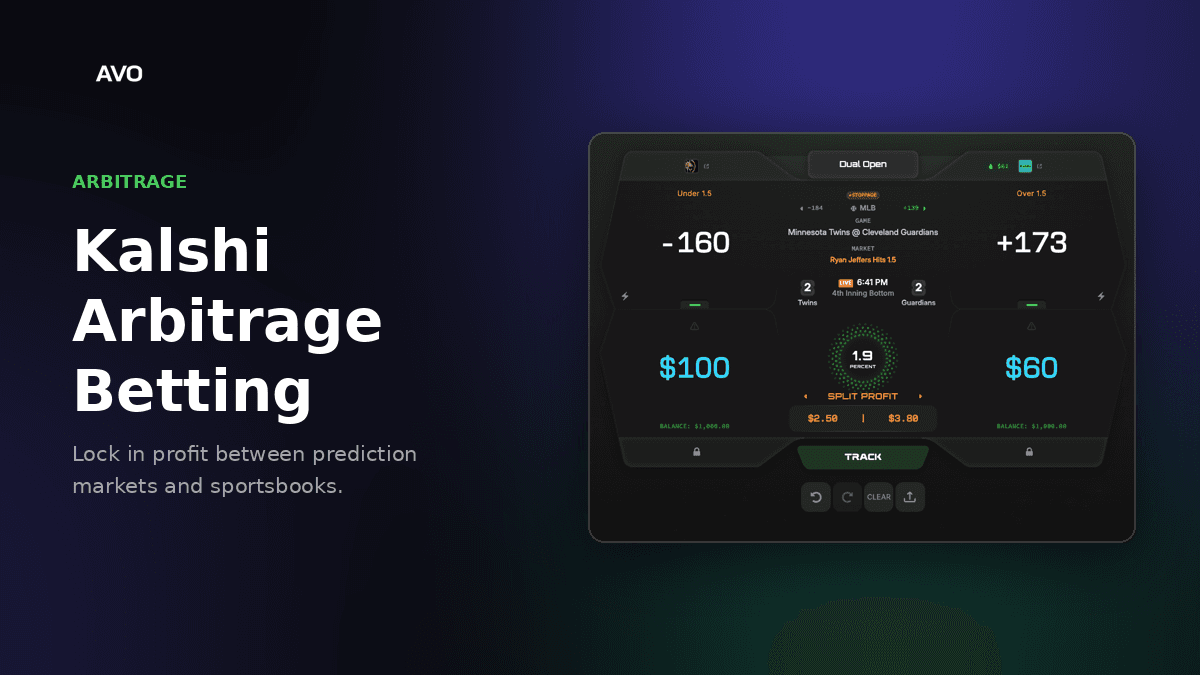
In July 2026, prediction markets pushed more than $50 billion in volume during the World Cup — outpacing several traditional sportsbooks for the first time. Kalshi sat at the center of that surge. And every time a new pool of money prices outcomes differently than the established sharp books, a familiar edge opens up for anyone paying attention: Kalshi arbitrage betting.
Kalshi arbitrage betting is the practice of buying one side of an outcome on Kalshi and the opposite side on a sportsbook (or another prediction market) so that, whatever happens, your combined position pays out more than it cost. It's the same math that powers traditional arbitrage betting — you're just doing it across two very different kinds of markets, which is exactly why the gaps are often wider. This guide walks through what Kalshi is, why these edges exist, a step-by-step example with real numbers, the fees most guides ignore, and how to find these opportunities before they close.
What Is Kalshi?
Kalshi is a federally regulated prediction market. Instead of betting against a sportsbook's line, you buy and sell event contracts — binary "Yes / No" positions on a real-world outcome. Each contract settles at $1.00 if the event happens and $0.00 if it doesn't.
The key insight for arbitrage is that a Kalshi contract's price is an implied probability. A contract trading at 48¢ means the market thinks there's a 48% chance the event happens. That makes it trivial to compare against a sportsbook: convert the sportsbook's odds to an implied probability, line the two numbers up, and look for a disagreement.
Because Kalshi is regulated by the CFTC as an exchange for "swaps" rather than as a sportsbook, its sports event contracts are currently available in most of the country — a status affirmed when a federal appeals court sided with Kalshi in April 2026. A handful of states with active court orders (including Nevada, Arizona, Ohio, Massachusetts, Michigan, Maryland, Montana, and Illinois as of mid-2026) are the exception. You can check the current state-by-state legal status of prediction markets before you trade.
What Is Kalshi Arbitrage Betting?
Kalshi arbitrage betting exploits the fact that two markets can price the same outcome differently at the same moment. When they disagree enough, you can cover every result and come out ahead no matter who wins. (New to the concept? Start with what is arbitrage betting for the fundamentals, then come back.)
Why do these gaps exist? Sharp sportsbooks aggregate money from professional bettors worldwide, so their prices are extremely efficient and they move within seconds of news. Kalshi aggregates a different crowd — retail traders, finance-minded speculators, and news followers — who don't always share that same sports-pricing edge, and its markets can lag the books by minutes. Two different crowds pricing the same game is a recipe for temporary mispricing, and mispricing is where arbitrage lives.
How Kalshi Arbitrage Betting Works, Step by Step
- Pick a market that exists on both platforms — a game moneyline, a series winner, an award race. Anything Kalshi lists that a sportsbook also prices.
- Convert everything to implied probability. Kalshi is already there (48¢ = 48%). For the sportsbook, run the American or decimal odds through an odds-to-probability calculator, or let AVO's prediction market calculator translate Kalshi cents straight into betting odds for you.
- Add the two sides together. If the implied probability of "Yes" on one platform plus the opposite outcome on the other adds up to less than 100%, an arbitrage exists. The gap below 100% is your gross margin.
- Size both stakes so the payouts match. This is where an arbitrage calculator earns its keep — it splits your bankroll so you win the same amount regardless of the result.
- Place both sides fast. Prediction-market arbitrage windows last seconds, not minutes.
A Worked Example
Say the Lakers are playing, and you're looking at the moneyline:
- Kalshi: "Lakers win — Yes" is trading at 48¢ (implied probability 48%).
- Sportsbook: the opponent to win is priced at +130 (decimal 2.30, implied probability 43.5%).
Add the two sides: 48% + 43.5% = 91.5%. That's well under 100%, leaving an 8.5% gross arbitrage margin — the kind of fat edge that shows up far more often between a prediction market and a sportsbook than between two sportsbooks.
With a $1,000 bankroll, you'd size the two legs so each outcome returns the same amount:
| Side | Where | Price | Stake | Returns if it wins |
|---|---|---|---|---|
| Lakers win | Kalshi (Yes @ 48¢) | 48¢ | $524.70 (≈1,093 contracts) | $1,093 |
| Opponent wins | Sportsbook (+130) | 2.30 | $475.30 | $1,093 |
| Total | $1,000 | $1,093 either way |
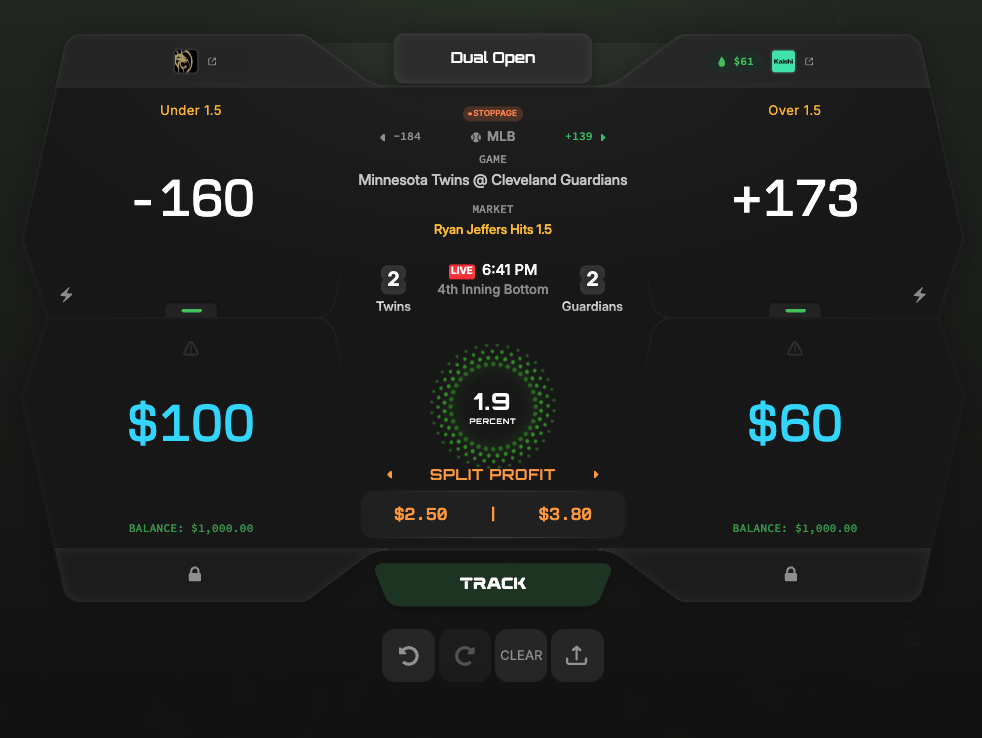
Whichever way the game goes, you collect ~$1,093 on a $1,000 outlay — about $93, or 9.3%, before fees. AVO's calculator sizes both legs for you and shows the locked-in split in real time:
Don't Forget the Fees — They're the Whole Game
Most Kalshi arbitrage guides quote the gross margin and stop there. That's how a "profitable" arb quietly turns into a loss. Kalshi charges a per-contract trading fee, roughly 0.07 × price × (1 − price) per contract, which is highest on mid-priced (near 50¢) contracts and capped around 7¢. In the example above, ~1,093 contracts at about 2¢ each is roughly $22 in fees, cutting your ~$93 down to about $71 net (7.1%).
Always net out fees before you place the bet. An 8.5% gross edge is real profit; a 2% gross edge on 50¢ contracts can vanish entirely once Kalshi's cut is taken. This is the single biggest reason to run the numbers through a tool rather than eyeballing them.
Kalshi vs. Sportsbook vs. Polymarket
There are two main flavors of Kalshi arbitrage betting:
- Kalshi vs. sportsbook — the version in the example above. Gaps tend to be larger because you're comparing two structurally different markets. This is where AVO focuses, since it already tracks odds across 70+ sportsbooks. If you're deciding which books to pair Kalshi against, see the best sportsbooks for arbitrage.
- Kalshi vs. Polymarket — arbitraging one prediction market against another. Gaps are usually tighter and fees on both sides matter even more, but they exist, especially on news-driven markets where one platform reprices faster than the other. We break that setup down in prediction market arbitrage.
Is Kalshi Arbitrage Betting Legal?
Trading Kalshi event contracts is legal in most U.S. states because Kalshi operates as a CFTC-regulated exchange, not a sportsbook — with the state exceptions noted earlier. Arbitrage itself isn't cheating: you're taking prices the markets are openly offering. That said, sportsbooks dislike arbitrage bettors and may limit accounts that do it aggressively, and prediction-market rules can change as the legal picture evolves. We cover the full question — including how sportsbooks detect arbitrage — in is arbitrage betting legal.
How to Find Kalshi Arbitrage Bets in Seconds
Doing this by hand — pulling up Kalshi, converting cents to odds, checking a sportsbook, sizing two stakes, netting fees — takes longer than the opportunity lasts. That's the entire problem AVO solves.
AVO's prediction market calculator converts Kalshi and Polymarket prices into betting odds instantly, and its arbitrage tool scans prices across 70+ sportsbooks in real time and sizes both sides for you. Built by former arbitrage bettors, AVO is designed to surface these edges — including prediction-market gaps — the moment they appear, so you can place both legs before the window closes.
Try AVO's arbitrage tool free →
Think of it less as gambling and more as spotting and acting on a pricing inefficiency faster than the market can correct it. That's the smart-money way to look at Kalshi arbitrage betting.
If you'd rather take one side of a mispriced market and accept some variance for a bigger long-run edge, the companion approach is expected-value betting — see what does EV mean in betting.
Frequently Asked Questions
Is Kalshi arbitrage betting profitable? It can be, but the edge is small per trade and fees matter enormously. Success comes from finding enough opportunities and sizing them correctly — not from any single home-run bet.
Is it risk-free? The market risk is fixed once both legs are placed, but real-world risks remain: a leg not filling, odds moving mid-execution, fees, and account limits. It's low-variance, not no-effort.
Do I need a sportsbook and a Kalshi account? For Kalshi-vs-sportsbook arbitrage, yes. For Kalshi-vs-Polymarket, you'd need accounts on both prediction markets instead.
Which states can trade Kalshi sports contracts? Most, as of mid-2026, with several exceptions under active court orders. Always confirm your state's current status before trading.
AVO is an entertainment tool for adults and an analytics platform — not a sportsbook. AVO does not accept wagers or hold funds. Must be of legal age (21+). Please bet responsibly.

