
Most bankroll advice is written for people who pick games. Bet 1% to 3% a game, never chase, done. That advice is fine, but it misses the problems that actually break advantage bettors: money stuck at the wrong sportsbook when an arb appears, bet sizes that ignore how big the edge is, and a bankroll spread so thin across ten accounts that none of them can fund a full bet.
This guide covers bankroll management the way arbitrage, positive EV and promo bettors need it: how much money you actually need, how to size every bet, how to split it across books, and the rules that keep a good process from being wiped out by a bad month.
The short version: keep a dedicated bankroll that you can afford to lose and never top it up from bill money. Size +EV bets as a small fraction of the bankroll (a quarter to a half of the Kelly criterion is the common range). For arbitrage, the limit is not risk but placement: you need a live balance at every book you want to bet, so split the bankroll across your accounts and rebalance as money builds up in the wrong places.
What Counts as Your Betting Bankroll
Your bankroll is the money you have set aside only for betting. It is not your savings, your rent or whatever happens to be in your checking account this week. Everything in this guide is a percentage of that number, so it has to be a real, separate amount.
For an advantage bettor, the bankroll is the total across every place your money sits:
- Balances at each sportsbook
- Funds on exchanges and prediction markets
- Cash you have withdrawn but plan to redeploy
- Bets that are placed but not yet settled
That last one matters more than it sounds. If $1,500 of a $5,000 bankroll is tied up in open bets over a weekend, you are really working with $3,500 until they settle.
How Big Should Your Bankroll Be?
There is no single right number, but each strategy has a practical floor. The question is not "how much can I win" but "how much do I need for this strategy to work at all."
| Strategy | What sets the minimum | A practical starting point |
|---|---|---|
| Promo conversion | Enough to fund the hedge side of each bonus bet | A few hundred dollars |
| Arbitrage | A live balance at every book you want to arb, big enough for one leg | Your typical leg size times the number of books |
| Positive EV | Enough that a long losing run at your bet size does not end you | 100 or more of your typical bets |
| Middles | Both legs, plus room for the small cost of misses | Similar to arbitrage |
Two worked examples make this concrete.
Arbitrage: if your typical leg is $200 and you want to be able to bet at five sportsbooks, you need about $1,000 just to have every account funded. Anything less and you will regularly see arbs you cannot place because the money is at the wrong book.
Positive EV: over a few thousand even-money bets, it is common to hit a stretch where you lose 30 more bets than you win, even with a real edge. Betting 1% of the bankroll per play, that stretch costs about 26% of it. Betting 5% per play, the same stretch costs nearly 80%. Bet size, not bankroll size, is what decides whether you survive variance.
AVO recommends starting with at least $250. Below that, a balance spread across several books leaves too little at each one to take the opportunities you find.
Unit Sizing: Flat, Percentage and Kelly
A unit is your standard bet size. How you set it depends on the kind of bet.
Flat units are the classic recommendation for people betting opinions, usually 1% to 3% of the bankroll per bet. They are easy to track and hard to get badly wrong.
Percentage betting recalculates the unit as the bankroll changes. After a losing stretch your bets automatically get smaller, which slows the bleeding. After a good stretch they grow.
Fractional Kelly is the standard for positive EV betting, because it sizes each bet to its edge. A 6% edge gets a bigger bet than a 1% edge. Full Kelly is too aggressive for almost everyone, since your edge estimates are never perfect, so most +EV bettors use a quarter to a half of it. Our guide to positive EV betting walks through the formula, and the Kelly criterion calculator does the math for any bet.
Bankroll Management for Arbitrage Betting
Arbitrage changes the problem. Once both legs are placed the outcome no longer matters, so the risk of ruin from a losing streak mostly disappears. What replaces it is a placement problem: can you get both bets down, at the right size, before the price moves?
Three rules cover most of it.
1. Size by total stake, not by side. An arb at +105 on one book and -102 on another, with $200 total, splits into about $98 and $102 and returns about $201.45 whichever side wins. The arbitrage calculator does this split for you. The point is that a "$200 arb" needs roughly $100 sitting at each book.
2. Cap your largest leg at what your smallest book can handle. If one account has been limited to $50 bets, every arb that uses that book is a $50 leg. Plan around your smallest active limits, not your largest balance.
3. Leave room for more than one open arb. On a busy slate you may have several arbs open across the same books before any of them settle. Keeping balances at roughly two or three times your typical leg means one open position does not block the next.
Arbitrage is not risk-free in practice. Voided bets, palpable errors and a price moving before your second leg is placed can all leave you exposed on one side. Keep enough slack that one of those does not knock out your whole week. Our guide on how to hedge a bet covers what to do when only one leg goes through.
How to Split Your Bankroll Across Sportsbooks
The biggest bankroll mistake advantage bettors make is not betting too big. It is having the money in the wrong place.
A workable approach:
- Fund every account you plan to use. An account with $0 in it is an account you cannot bet.
- Spread mainstream sportsbook money evenly, then let your results tell you where to add more.
- Keep a larger balance at your exchange. It is the account least likely to limit you, so it ends up on one side of a growing share of your bets.
- Hold a small cash reserve outside the books for topping up whichever account runs dry first.
Which books belong in that list depends on your state. Our guide to the best sportsbooks for arbitrage betting covers the portfolio in detail, and AVO's sportsbook finder shows which supported books are live where you are.
Keeping Money Where the Opportunities Are
Arbitrage and +EV betting both move money around. The winning side of each arb lands at whichever book took that bet, so over a few weeks balances drift. Some accounts swell, others run dry.
Rebalance on a schedule rather than when you are stuck:
- Weekly, check every balance against your target split.
- Withdraw from accounts that are well over target and redeploy to the ones that are short.
- Move money between books with bets, not withdrawals, when a withdrawal would take days. Low-hold bets on opposite sides shift funds from one book to another at a small cost. AVO's $Mover tool finds those pairings for you.
- Keep limited accounts funded at a lower level. A limited account still works as the smaller leg of an arb and still collects promos, so it does not need to be closed, just right-sized.
For the habits that keep accounts open longer in the first place, see how to avoid getting limited by sportsbooks.
Track Everything
You cannot manage a bankroll you cannot see. At a minimum, log for every bet:
- Date, sportsbook, market and odds
- Stake and result
- Strategy (arb, +EV, middle, promo)
- The closing odds, for +EV bets
From that you can answer the questions that actually matter: what is my return on investment by strategy, which books produce most of my profit, and am I beating the closing line? For +EV betting, closing line value is the best early signal that your process works, long before the profit shows up. AVO tracks bets you place through the dashboard, so you can review results by strategy, sport and sportsbook.
Rules That Protect Your Bankroll
The math only works if the bankroll survives. These rules are the ones experienced bettors keep coming back to.
Set a deposit limit with each sportsbook and decide in advance what you will do if the bankroll drops by a set amount, for example pausing and reviewing your bet sizes at a 25% drawdown. If betting stops feeling like a process and starts feeling like chasing, step away. The National Council on Problem Gambling offers free, confidential help, and every US sportsbook offers deposit limits and self-exclusion tools.
How AVO Helps You Manage a Bankroll
Most of the work above is bookkeeping, and that is the part AVO automates.
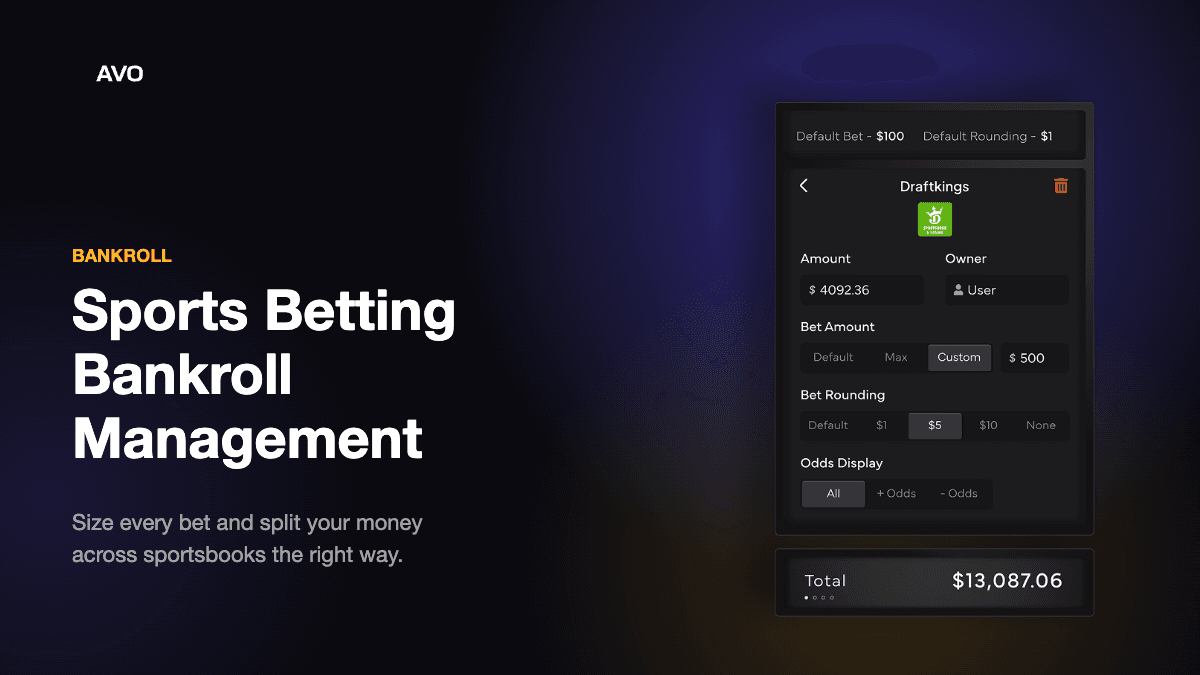
AVO's wallet keeps a balance for every sportsbook you use and a running total across all of them. You set a default bet size and rounding once, then override them per book. A book that has been limited can carry a smaller custom bet amount, and rounding to $5 keeps stakes looking like normal bets. When AVO surfaces an arbitrage bet, the stakes follow the bet size and rounding you set for each book. For positive EV bets, you see a recommended stake from your bankroll and Kelly setting.
Try AVO Pro for 3 days for $1 →
Frequently Asked Questions
What is bankroll management in sports betting? Setting aside a fixed amount of money for betting and sizing every bet as a planned share of it, so normal losing runs cannot wipe you out and your bet sizes match the edge you have.
How much of my bankroll should I bet per game? For opinion betting, 1% to 3% per bet is the common range. For positive EV betting, most bettors use a quarter to a half of the Kelly criterion, which often works out to 1% to 3% as well, scaled to the size of each edge.
How much money do I need for arbitrage betting? Enough to keep a live balance at every sportsbook you want to arb, each one big enough for a typical leg. With five books and $200 legs, that is about $1,000 before any slack.
How should I split my bankroll across sportsbooks? Fund every account you plan to use, spread mainstream sportsbook money evenly, keep a larger balance at an exchange because it is least likely to limit you, and rebalance weekly.
What is a unit in sports betting? Your standard bet size, usually expressed as a percentage of your bankroll. Talking in units instead of dollars makes results comparable as the bankroll grows or shrinks.
Should I use full Kelly? Almost never. Full Kelly assumes your edge estimates are exact, and it produces large swings. A quarter to a half Kelly keeps most of the growth with far less risk.
AVO is an entertainment tool for adults and an analytics platform, not a sportsbook. AVO does not accept wagers and does not hold funds. You must be of legal age to bet in your jurisdiction (21+ in most states). Examples are illustrative, and betting involves real risk of loss. If you or someone you know has a gambling problem, call 1-800-GAMBLER. Please bet responsibly.

