
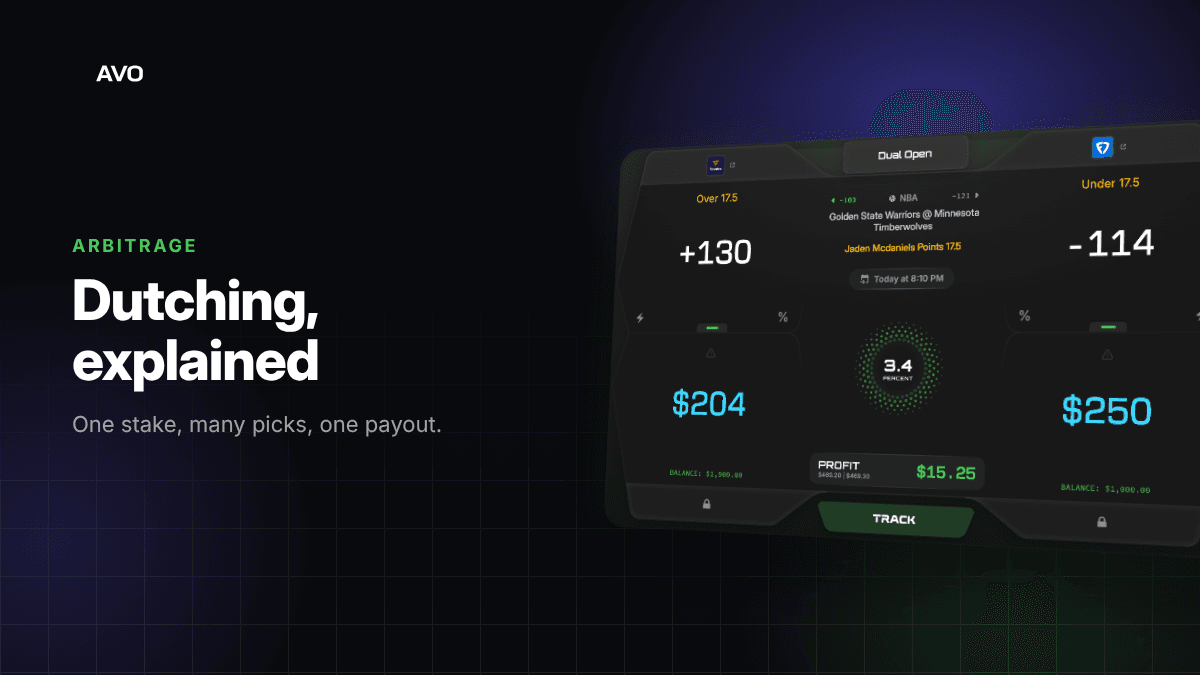
You like three golfers to win this week's tournament, and you can't decide between them. Betting the same amount on each means the longest shot pays far more than the favorite, so your result depends on which of your three picks gets there. Dutching fixes that. A dutching calculator splits one total stake across several outcomes so that whichever of them wins, you collect the same payout.
The short version: Dutching means backing two or more outcomes in the same market, with each stake sized by its odds, so every winning selection returns the same amount. The stake on each pick is your total stake times that pick's implied probability, divided by the sum of the implied probabilities. If the implied probabilities of every outcome in a market add up to less than 100%, dutching all of them is an arbitrage. Otherwise it is a way to spread risk, not a way to remove it.
What Is Dutching in Betting?
Dutching is a staking method. Instead of picking one winner, you pick a group of outcomes you think contains the winner, then divide your money between them in proportion to their chances as the odds see them. Shorter prices get bigger stakes, longer prices get smaller stakes, and the payout lines up across the whole group.
The name traces back to Dutch Schultz, the 1930s New York gangster who is said to have used the approach on horse races. You can read the short history on Wikipedia's dutching page. In the UK it is mostly a horse racing tool, while US bettors use it more on futures, golf outrights, first touchdown scorer markets and other markets with many possible winners.
Two things are true about every dutch:
- If any of your selections wins, you get the same return.
- If none of them wins, you lose the whole stake.
That second point is why dutching is not risk free. It narrows the range of outcomes you need, but you still need one of your picks to land, unless you cover every outcome in the market.
How a Dutching Calculator Works
Every dutching calculator runs the same math. It converts each price into an implied probability, adds them up, and gives each selection its share of the total stake.
The sum of the implied probabilities is the key number. Call it the book. For a dutch on part of a market, the book tells you how much of the field you are covering according to the odds. For a dutch on the whole market, a book under 100% means a profit no matter what happens, and a book over 100% means a small loss no matter what happens.
If you only have American odds, convert first. A positive price of +400 becomes 5.00 in decimal (400 ÷ 100 + 1). A negative price of -150 becomes 1.667 (100 ÷ 150 + 1). Our implied probability calculator does both steps for you.
A Worked Dutching Example
Say you want $100 on three golfers to win a tournament:
- Golfer A at +400 (decimal 5.00), implied 20.00%
- Golfer B at +500 (decimal 6.00), implied 16.67%
- Golfer C at +700 (decimal 8.00), implied 12.50%
The book for your three picks is 20.00% + 16.67% + 12.50% = 49.17%.
Now split the $100:
- Golfer A: $100 × 20.00 ÷ 49.17 = $40.68
- Golfer B: $100 × 16.67 ÷ 49.17 = $33.90
- Golfer C: $100 × 12.50 ÷ 49.17 = $25.42
Those add up to $100.00. Check the returns: $40.68 × 5 = $203.40, $33.90 × 6 = $203.40, and $25.42 × 8 = $203.36. Rounding to the cent leaves a few cents of difference, which is normal.
So the dutch turns three separate bets into one position: about +$103 if any of your three golfers wins, -$100 if the field beats all of them. It behaves like a single bet at roughly +103, or decimal 2.03, on "A, B or C wins."
Two Ways to Size a Dutch: Total Stake or Target Payout
Most dutching calculators let you work from either end.
Total stake method. You decide how much to risk in total, and the calculator splits it. That is what we did above with $100.
Target payout method. You decide what you want back if one of your picks wins, and each stake is simply that target divided by the decimal odds. For a $300 return on the same three golfers:
- Golfer A: $300 ÷ 5 = $60.00
- Golfer B: $300 ÷ 6 = $50.00
- Golfer C: $300 ÷ 8 = $37.50
The total stake is $147.50, and any of the three winning returns $300, a $152.50 profit. The second method is handy when you want a round number back, or when a sportsbook caps how much you can win on one market.
A practical note: books sometimes reject odd cents or round stakes for you. If you round every stake to whole dollars ($41, $34, $25), the returns become $205, $204 and $200. Still close, but no longer equal. Round the biggest stake last and recheck the payouts before you place anything.
Dutching vs Arbitrage Betting
Dutching and arbitrage use the same staking math, which is why they get mixed up. The difference is coverage.
| Dutching | Arbitrage | |
|---|---|---|
| Outcomes covered | Some of the market | Every outcome in the market |
| Can you lose? | Yes, if none of your picks win | No, if all bets stand at the prices taken |
| Books used | Often one book | Usually two or more books |
| Main goal | Spread risk across picks you like | Lock in profit from a price gap |
In other words, arbitrage betting is a dutch that covers every outcome at prices whose book adds up to less than 100%. A dutch that covers only part of the market is a bet with a view. You still need to be right about which group contains the winner.
That is also how dutching relates to a middle. A middle uses two sides of a line at different numbers to create a window where both bets win. A dutch gives every winning outcome the same payout, so there is no jackpot result, only one flat return.
When Dutching Becomes an Arb: A 3-Way Soccer Example
Soccer moneylines have three outcomes: home, draw and away. If you can find each one at a different book with prices good enough, dutching all three is an arbitrage.
Say you find:
- Home win at +140 (decimal 2.40), implied 41.67%
- Draw at +245 (decimal 3.45), implied 28.99%
- Away win at +260 (decimal 3.60), implied 27.78%
The book is 41.67% + 28.99% + 27.78% = 98.43%. Under 100%, so there is an edge. With $500 total:
- Home: $500 × 41.67 ÷ 98.43 = $211.66
- Draw: $500 × 28.99 ÷ 98.43 = $147.24
- Away: $500 × 27.78 ÷ 98.43 = $141.10
The payout is $500 ÷ 0.9843 = about $507.98 whichever result happens. Check: $211.66 × 2.40 = $507.98, $147.24 × 3.45 = $507.98, $141.10 × 3.60 = $507.96. That is roughly $7.97 profit on $500, about 1.6%.
Finding three prices like that by hand, across separate books, before they move, is the hard part. That is the job of an arbitrage betting tool: AVO scans 103+ sportsbooks and exchanges and shows each arb with the stakes already split. With Dual Open you can open both betslips at once, which matters because a 1.6% edge can vanish in seconds.
Does Dutching Make Money? The EV Question
Dutching changes the shape of your results. It does not change their expected value. The EV of a dutch is just the sum of the EV of each bet inside it. If every leg is a bad price, the dutch is a bad bet, only with smoother results.
Go back to the golf example. The dutch pays $203.39 for every $100, which needs the three golfers to win a combined 49.17% of the time to break even. Now plug in your own estimate:
- If you think the three of them really win 45% of the time, your EV is 0.45 × $203.39 - $100 = -$8.47 per $100.
- If you think they win 55% of the time, your EV is 0.55 × $203.39 - $100 = +$11.86 per $100.
So the question is never "should I dutch?" It is "are these prices good?" Outright markets often carry a big hold, so a dutch across a futures board can easily cost more than it looks. Price each leg against a sharper market first. The positive EV betting approach and line shopping both help here: the best price on each pick lowers your book and raises the payout.
Where Dutching Fits in US Betting
Dutching works best in markets with several plausible winners and fixed odds:
- Futures and outrights: MVP races, championship winners, golf tournaments.
- Player props with many outcomes: first touchdown scorer, first goal scorer.
- Exact result markets: correct score, winning margin bands.
- 3-way markets: soccer and hockey regulation results, where covering all three outcomes turns the dutch into an arb.
US horse racing is a special case. Most US racing is pari-mutuel, so the final odds are not known until the pool closes. A dutch built on the tote board a few minutes before post can drift out of balance by the time the race goes off.
You can also dutch across books. Nothing says all three stakes must sit at the same sportsbook. Taking the best price for each pick at a different book lowers your book percentage and raises your payout, which is the same idea behind line shopping.
Common Dutching Mistakes
- Covering too much of the field. Every extra pick adds to the book. Dutch eight longshots in a futures market and the payout can drop close to your stake while you still lose if the favorite wins.
- Ignoring the hold. A dutch across one book's prices inherits that book's margin on every leg. Check the price of each pick elsewhere.
- Placing legs at different times. If one price moves before you place the next bet, your stakes no longer balance. Recalculate with the new price, or skip it.
- Forgetting limits and voids. If a book cuts one stake or a leg gets voided (for example, a golfer withdraws), the rest of the dutch is out of balance. Know each market's rules before you place it.
- Treating it as free money. Unless you cover every outcome below 100%, dutching is still a bet. If you want to protect an existing position instead, hedging a bet is often the better tool.
If you want to see real cross-book price gaps instead of hunting for them by hand, find live arbs with AVO → or try AVO Pro for 3 days for $1 →.
Frequently Asked Questions
What does dutching mean in betting? Dutching means backing several outcomes in the same market, with stakes sized so every winning pick returns the same amount. Bigger stakes go on shorter prices and smaller stakes on longer prices.
How do you calculate dutching stakes? Convert each price to decimal odds, then find each implied probability (1 ÷ odds). Each stake is your total stake times that pick's implied probability, divided by the sum of all the implied probabilities you are covering.
Is dutching the same as arbitrage? Not quite. Arbitrage is a dutch that covers every outcome in a market at prices whose implied probabilities add up to less than 100%. A regular dutch covers only some outcomes, so you can still lose.
Is dutching profitable? Only if the prices are good. Dutching smooths your results but keeps the same expected value as the individual bets inside it. A dutch built from -EV prices is still -EV.
Can you dutch across different sportsbooks? Yes. Taking the best available price on each pick, even at different books, lowers the total book and increases your payout. Just place the bets quickly so the prices don't move.
What sports are best for dutching? Markets with many possible winners: golf, futures, first scorer props and correct score. Soccer and hockey 3-way markets are also popular, since covering all three outcomes can create an arb.
AVO is an entertainment tool for adults and an analytics platform, not a sportsbook. AVO does not accept wagers and does not hold funds. You must be of legal age to bet in your jurisdiction (21+ in most states). Examples are illustrative, and betting involves real risk of loss. If you or someone you know has a gambling problem, call 1-800-GAMBLER. Please bet responsibly.

