
You like the Bills -3 on Sunday, so you open your usual sportsbook and bet it at -110. A friend bets the exact same side at another book at -105, and a third book had the Bills at -2.5 the whole time. Same game, same pick, three different prices. If the Bills win by exactly 3, one of you wins, one of you pushes, and over a season the person who always takes the best number keeps more of every win. That habit has a name: line shopping.
This guide explains what line shopping is, shows the math on why small price differences matter so much, and walks through a simple way to find the best odds before every bet.
The short version: line shopping is comparing the odds for the same bet across several sportsbooks and placing it wherever the price is best. Books set their lines independently, so the same spread, total, moneyline or prop is often priced differently from one book to the next. Taking -105 instead of -110 lowers your break-even win rate from 52.38% to 51.22%. Over hundreds of bets, that gap can be the difference between losing money and making it.
What Is Line Shopping?
Line shopping is the practice of checking the same betting market at multiple sportsbooks and betting it at the one offering the best price. "Line" covers both parts of a bet: the number (a spread of -3 or a total of 47.5) and the odds attached to it (-110, +150 and so on).
Sportsbooks don't all copy one master line. Each book sets and moves its own prices based on its customers, its exposure and how quickly it reacts to news. Some books lead the market and some follow it, which our guide to sharp sportsbooks explains in detail. The result is that at almost any moment, the same bet is priced differently across the legal books in your state.
A line shopper doesn't change what they bet. They change where they bet it. It is the closest thing in sports betting to buying the exact same product at a lower price.
Why the Best Odds Matter More Than You Think
Odds are a price, and the price decides how often you need to win to break even. The American odds on a bet convert directly to a break-even win rate:
- -115: 115 / 215 = 53.49%. A $100 bet wins $86.96.
- -110: 110 / 210 = 52.38%. A $100 bet wins $90.91.
- -105: 105 / 205 = 51.22%. A $100 bet wins $95.24.
- +100: 100 / 200 = 50.00%. A $100 bet wins $100.
Moving from -110 to -105 takes more than a full percentage point off the win rate you need. That sounds small until you remember how thin the margins are. A bettor who wins 53% of spread bets is doing well. At -115, that same bettor is losing money. At -105, they are comfortably ahead.
This is why the vig matters so much. A market priced -110 on both sides has a hold of about 4.55%. Line shopping lets you take the best side of two different books. If Book A has Team A -105 / Team B -115 and Book B has Team A -115 / Team B -105, each book on its own holds about 4.5%. Take Team A at Book A and Team B at Book B, and the combined market you are betting into is 51.22% + 51.22% = 102.44%, a hold of about 2.38%. You have cut the cost of betting roughly in half without changing a single pick.
Same Picks, Three Different Results
Here is what that looks like over a real sample. Say you make 500 spread bets of $100 each and win 265 of them, a 53% win rate. The only thing that changes below is the price you got.
The math behind each row:
- -115: 265 × $86.96 = $23,043.48 in wins, minus $23,500 in losses = -$456.52.
- -110: 265 × $90.91 = $24,090.91 in wins, minus $23,500 = +$590.91.
- -105: 265 × $95.24 = $25,238.10 in wins, minus $23,500 = +$1,738.10.
- +100: 265 × $100 = $26,500 in wins, minus $23,500 = +$3,000.00.
Same handicapping, same wins and losses. The bettor who always took -105 instead of -110 made almost three times as much. The bettor stuck at -115 lost money while picking winners 53% of the time. You will rarely find +100 on a standard spread, but the row shows where the money goes: every cent of price you give up comes straight out of your profit.
Line Shopping on Spreads and Totals: The Value of a Half Point
On spreads and totals, books often disagree on the number itself, not just the odds. One book has the Bills -3, another has them -2.5. One book has a total of 47.5, another has 46.5.
A half point only matters when the final margin lands right on it, but some numbers come up far more often than others. In the NFL, more games end with a 3-point margin than any other, and 7 is close behind. These are called key numbers. Getting -2.5 instead of -3 turns every 3-point win from a push into a win. Getting +3.5 instead of +3 turns every 3-point loss from a push into a win.
That is why books often hold -3 and change the odds instead, moving from -3 -110 to -3 -120 rather than giving up the half point. When you shop, compare both parts:
- Same number, different odds: take the better odds. -3 -105 beats -3 -110.
- Different number, similar odds: take the better number. -2.5 -110 beats -3 -110.
- Better number, worse odds: it depends on the key number. Around 3 and 7 in the NFL, a half point is usually worth more than 5 to 10 cents of odds. Around numbers that rarely land, like 5 or 9, it usually isn't.
Totals work the same way. Some combined scores land more often than others because of how football scoring works in 3s and 7s, so a half point on a total can matter too, though usually less than a half point around 3 or 7 on a spread.
Line Shopping on Moneylines and Player Props
Moneylines have no number to shop, only odds, and the gaps can be wider than people expect, especially on underdogs.
Say one book has an underdog at +140 and another has the same team at +155. A $100 bet returns $140 in profit at one and $155 at the other. Now suppose the team's true chance of winning is 41%:
- At +140: 0.41 × $140 - 0.59 × $100 = $57.40 - $59.00 = -$1.60 per $100.
- At +155: 0.41 × $155 - 0.59 × $100 = $63.55 - $59.00 = +$4.55 per $100.
Same team, same game. One price is a losing bet and the other is a winning one. The break-even rates show why: +140 needs 100 / 240 = 41.67% to break even, and +155 needs only 100 / 255 = 39.22%.
Player props are where line shopping pays the most. Books have to price thousands of props a day, so they are slower to react and disagree more often. You will regularly see one book with a player at 24.5 points and another at 23.5, or the same 6.5 rebounds priced at -105 at one book and -135 at another. If you bet props without shopping, you are almost certainly leaving money on the table on a large share of your bets.
How to Line Shop in Sports Betting, Step by Step
You don't need a complicated system. You need accounts at a few books and a fast way to compare them.
- Open accounts at several legal sportsbooks. The more books you can bet at, the better your best price will be. Even three or four books make a real difference.
- Decide what you want to bet before you shop. Line shopping is for getting the best price on a bet you already like, not for finding reasons to bet.
- Compare the same market everywhere. Make sure you are comparing the same thing: full game vs first half, the same player stat, and the same overtime rules.
- Place it at the best price, fast. Prices move. If the best number is only at one book, it may not be there in five minutes.
- Track what you got. Log the odds you took and the closing odds. Beating the closing line regularly is one of the best signs that your process is working.
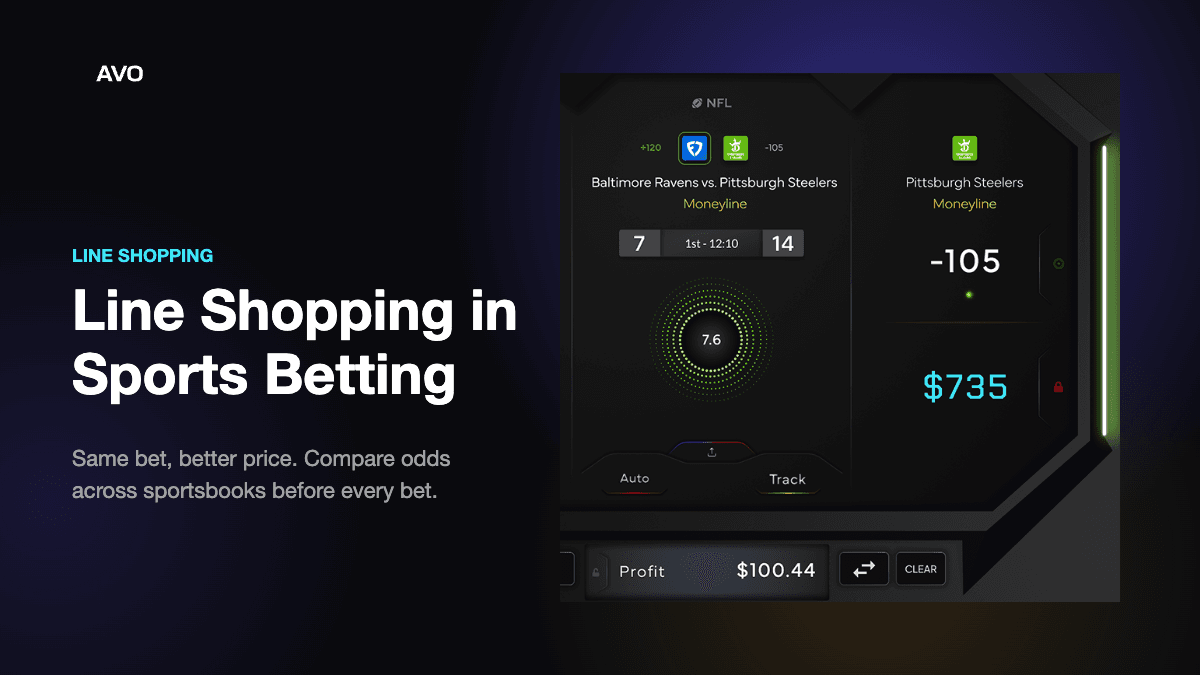
Checking a dozen apps by hand before every bet gets old fast, which is why most serious bettors use an odds screen. AVO's odds screen shows the same market across 70+ sportsbooks in one view, so the best price is obvious in seconds.
Line Shopping vs Arbitrage and +EV Betting
Line shopping is the foundation that more advanced strategies are built on.
- Line shopping means you already like a bet and you find the best price for it. Your edge still depends on your picks.
- Positive EV betting uses sharp market prices to estimate the true odds, then bets only where a book's price beats that estimate. Our guide to positive EV betting covers the full process, and how to devig odds explains how the fair price is calculated.
- Arbitrage betting happens when books disagree so much that you can bet every side at different books and lock in a return whatever the result. Our guide on what is arbitrage betting explains how that works.
All three start with the same habit: comparing prices across books. Line shopping is the version anyone can start today, with no extra math. It also helps when you need to cover an existing position. If you plan to hedge a bet, shopping for the best price on the hedge side lowers what that protection costs you.
How Many Sportsbooks Do You Need?
More is better, but the gains slow down. Going from one book to three is a huge jump. Going from eight to ten is a small one. A practical setup for most bettors:
- Start with three to five books that are legal in your state, ideally a mix of the biggest names and a few smaller ones, since smaller books are often slower to move their lines.
- Add an exchange or a sharper book if one is available to you. Their prices are a useful benchmark even when you don't bet there.
- Keep money in each account. The best price only helps if you can bet it right away. Our bankroll management guide covers how to split a bankroll across books without leaving too much idle in any one of them.
One caution: books notice accounts that always take their best prices, especially on props and stale lines. Line shopping on its own is normal behavior, but if most of your bets come in at prices that are better than the rest of the market, some books will eventually limit you. Our guide on how to avoid sportsbook limits covers how to stay active longer.
Common Line Shopping Mistakes
- Assuming your favorite book is always competitive. Every book is the best price on some markets and the worst on others. Loyalty costs money.
- Comparing different markets. A full-game total and a regulation-only total are different bets. So are props with different settlement rules. Compare like with like.
- Ignoring parlays and same-game parlays. Prices on combined bets vary enormously between books. If you bet them at all, shopping matters even more.
- Shopping only the big games. Lines on high-profile NFL games are usually tight. Small-market games, college sports and props are where the gaps are widest.
- Forgetting about promos. A boost or a bonus bet can make a book the best price on a market for a short time. Factor it in, but read the terms.
Frequently Asked Questions
What is line shopping in sports betting? It means comparing the odds for the same bet at several sportsbooks and placing it wherever the price is best. You make the same pick, just at a better price.
Does line shopping really make a difference? Yes. Taking -105 instead of -110 lowers your break-even win rate from 52.38% to 51.22%. Over 500 bets at a 53% win rate and $100 a bet, that is the difference between about +$591 and +$1,738.
How many sportsbooks should I use to line shop? Three to five legal books is a strong start. More books give you more chances at the best price, but the gains get smaller after the first few.
Is line shopping legal? Yes. Choosing which legal, licensed sportsbook to place a bet with is completely normal. Books may still limit accounts that consistently beat their prices.
Where can I find the best odds for sports betting? An odds screen shows the same market across many books at once. AVO compares odds across 70+ sportsbooks, so you can see the best available price in one view.
What is a key number in sports betting? A final margin that comes up more often than others, like 3 and 7 in the NFL. A half point around a key number is worth more than a half point anywhere else.
Compare odds across 70+ sportsbooks with AVO →
Try AVO Pro for 3 days for $1 →
AVO is an entertainment tool for adults and an analytics platform, not a sportsbook. AVO does not accept wagers and does not hold funds. You must be of legal age to bet in your jurisdiction (21+ in most states). Examples are illustrative, and betting involves real risk of loss. If you or someone you know has a gambling problem, call 1-800-GAMBLER. Please bet responsibly.

