
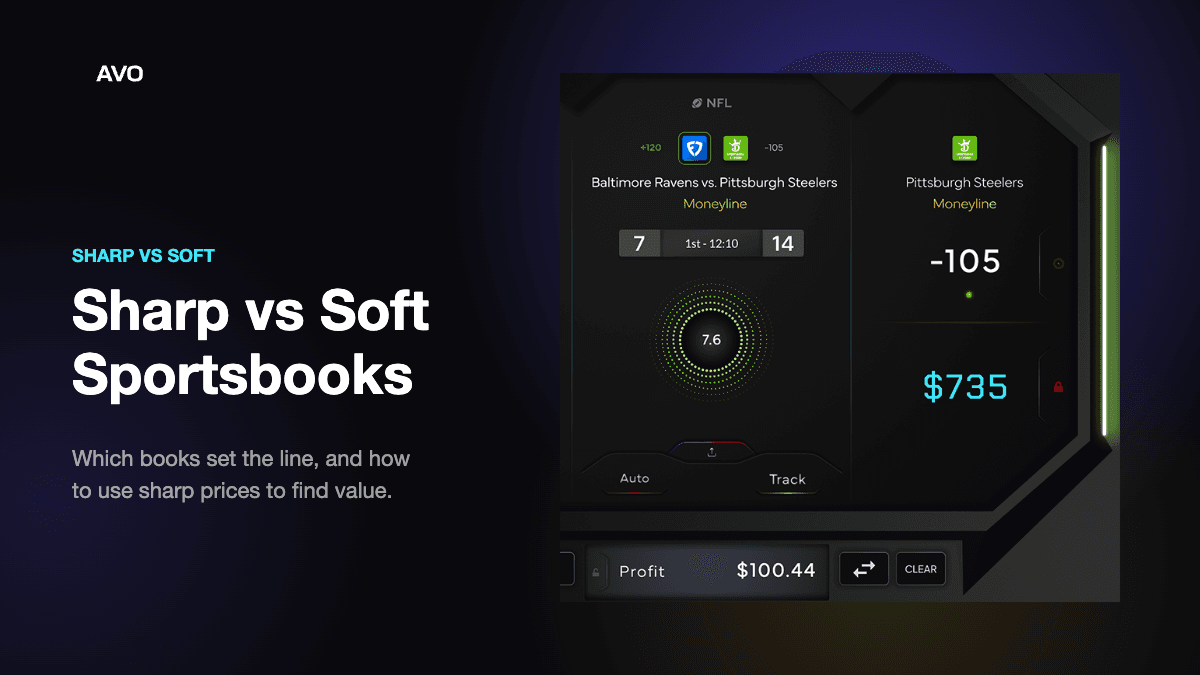
Every sportsbook posts odds, but they don't all play the same role. A few sharp sportsbooks build their own numbers, take big bets from winning players and move fast when they learn something. Most of the others watch them and adjust. If you can't tell which kind of book you're looking at, you can't tell whether a price is the market's best guess or a stale number about to change.
This guide explains what makes a book sharp or soft, why the difference exists, how to spot each one, and how advantage bettors use sharp prices to find value at soft books.
The short version: sharp sportsbooks are the books whose prices the rest of the market treats as the reference. They run low margins, take high limits and welcome winning bettors, because those bettors help them set accurate lines. Soft books are recreational books that follow the market and limit winners. Advantage bettors use the sharp price as an estimate of the true odds, then bet at soft books when their price is better than that estimate.
What Is a Sharp Sportsbook?
A sharp sportsbook is a book that sets the market rather than following it. Its odds are treated as the best available estimate of an event's real probability, and other books move toward its number.
Three traits show up again and again:
- Low margin. A sharp book's two-way markets often price around -105 on each side instead of -110, so it keeps less of every dollar bet.
- High limits. It takes large bets, especially close to game time, because big bets carry information.
- Tolerance of winners. It doesn't limit bettors just for winning. A sharp book wants sharp money, since sharp action tells it where the line should be.
The business model is volume at a thin margin. A sharp book makes money by taking a lot of action at accurate prices and moving the line whenever smart money shows it was wrong.
What Is a Soft Sportsbook?
A soft sportsbook, sometimes called a recreational or retail book, makes most of its money from casual bettors. Its edge comes from wider margins, parlays, same game parlays and promotions rather than from pricing every market perfectly.
Soft books usually:
- Copy or adjust toward the market on major markets instead of originating their own number.
- Shade lines toward popular sides, like favorites and big-market teams, because they know where casual money goes.
- Carry higher margins, often -110 on both sides of a spread and much more on props and parlays.
- Limit winning accounts, sometimes quickly. A book that expects to profit from casual bettors has little reason to keep a consistent winner.
Soft does not mean bad. Soft books are where most promos, boosts and pricing mistakes live, which is exactly why advantage bettors want accounts there.
Sharp vs Soft Sportsbooks Side by Side
The margin difference sounds small, but it adds up. A market at -110 on both sides has a hold of about 4.55%. A market at -105 on both sides has a hold of about 2.38%. That is roughly half the cost per bet, before you even consider which side has value.
Here is the math. At -110, the implied probability of each side is 110 / 210 = 52.38%. Both sides together add to 104.76%, so the book keeps 1 - (1 / 1.0476) = 4.55% of the money in a balanced market. At -105, each side is 105 / 205 = 51.22%, the total is 102.44%, and the hold is 2.38%. The vig is the price you pay to bet, and sharp books charge less of it.
Why Sharp Books Welcome Winning Bettors
It sounds backwards for a sportsbook to want customers who beat it. The logic is that a sharp book is in the information business.
When a respected bettor hits a line at a sharp book, the book loses a little on that bet but learns that its number was off. It moves the line, and every bet taken afterward is priced more accurately. Over thousands of markets, accurate prices plus thin margins and high volume is a profitable model.
A soft book has a different model. It earns its margin from bettors who don't have an edge. A sharp bettor at a soft book is a pure cost, so the soft book limits that account. That is why most advantage bettors end up limited at some soft books eventually, and why our guide on how to avoid getting limited by sportsbooks is mostly about looking like a normal customer for longer.
Which Books Are Sharp in the US?
The globally best-known sharp books are not licensed in the US, and we don't cover offshore books at AVO. Inside the regulated US market, the picture is smaller but still useful.
- Circa Sports is the US-licensed book most often described as sharp. It is known for high limits and low margins, and as of October 2026 it offers online betting in Colorado, Illinois, Iowa, Kentucky, Missouri and Nevada, with an Arizona license approved in 2026 and no launch date announced yet.
- Betting exchanges and peer-to-peer platforms let bettors trade with each other, so prices are set by sharp and recreational money together, with a small commission instead of a built-in margin. Which platforms are live, and where, has changed a lot in 2026, so check your state before you count on one.
- Prediction markets that list sports contracts work in a similar way. Their prices often move with the sharp market because traders arbitrage them against sportsbooks.
The large national books are generally treated as retail books on most markets. That is not a knock on them. It means their price on a given market is usually better read as "the book's offer" than as "the market's best estimate."
Sharpness is also market by market. A retail book can be quick and accurate on NFL sides while being slow on niche props. Always judge a book on the specific market you're betting.
How to Tell If a Book Is Sharp or Soft
You don't need inside information. A few checks reveal a book's role quickly.
As a rough guide, a sharp two-way market at -105 / -105 holds about 2.38%, a standard -110 / -110 market holds 4.55%, and a soft prop priced -125 / -105 holds about 6.35%.
- Compare the hold. Add up the implied probability of every outcome. The closer the total is to 100%, the sharper the price. Our no-vig fair odds calculator does this for any market.
- Watch who moves first. When news breaks or a big bet lands, sharp books move within seconds. Soft books follow minutes later. An odds screen makes this easy to see.
- Look at limits. Books that take large bets close to game time are confident in their prices. Books with low limits on the same market are not.
- Check how they treat winners. If a book limits accounts that beat the closing line, it is running a soft model.
Using Sharp Lines to Find +EV Bets at Soft Books
This is where the sharp versus soft difference turns into money. If the sharp price is the best estimate of the true odds, then any soft book offering a better price than that estimate is offering a positive expected value bet.
Walking through the math:
- Team A at -120 implies 120 / 220 = 54.55%. Team B at +110 implies 100 / 210 = 47.62%. Together that is 102.17%.
- Removing the vig proportionally gives Team A 54.55 / 102.17 = 53.39% and Team B 47.62 / 102.17 = 46.61%.
- At +125, a $100 bet on Team B wins $125. Expected value = 0.4661 × $125 - 0.5339 × $100 = $58.26 - $53.39 = +$4.87 per $100, or about +4.9%.
One bet like that can still lose. The edge shows up over hundreds of bets, which is why bet sizing matters. Our guide to positive EV betting covers the full process, and what EV means in betting explains the formula in more depth.
Doing this by hand across dozens of books and thousands of markets isn't realistic. AVO's positive EV betting tool devigs sharp prices across 70+ sportsbooks and flags soft-book prices that beat them in real time.
Sharp Books, Soft Books and Arbitrage
Arbitrage comes from the same gap. When a sharp book moves and a soft book hasn't caught up yet, the two prices can briefly disagree enough that betting both sides locks in a profit.
The difference is in what you're relying on. A +EV bet trusts the sharp price as the true odds and takes one side. An arb doesn't need to know the true odds at all, because both sides are covered. In practice, most arbs pair a soft book that is slow to move with a sharper book or exchange that already has. Our guide to the best sportsbooks for arbitrage betting covers how to build an account list with both kinds of book.
Common Mistakes When Reading Sharp Lines
- Treating one book as gospel. Even sharp books are wrong sometimes, especially early in the week or on thin markets. A consensus of several sharp prices is stronger than one.
- Ignoring market type. A book that is sharp on NFL spreads may be slow on player props. Judge sharpness per market.
- Betting stale numbers that are about to be fixed. If the soft book's price is better only because the line just moved, the window is short. Speed matters.
- Forgetting limits. A big edge at a book that will only take $25 is worth less than a modest edge at a book that takes $500.
- Chasing results. Judge sharp-line betting by closing line value and a large sample, not by last weekend.
Frequently Asked Questions
What are sharp sportsbooks? Books whose odds the market treats as the reference price. They run low margins, take high limits, welcome winning bettors and move first when new information arrives.
What is a sharp bettor? A bettor who consistently beats the market, usually measured by beating the closing line over a large number of bets. Sharp bettors move lines at sharp books and get limited at soft books.
Which sportsbook is the sharpest in the US? Circa Sports is the US-licensed book most often described as sharp, thanks to its high limits and low margins. Exchanges and prediction markets also tend to track the sharp market closely. Availability depends on your state.
Are DraftKings and FanDuel sharp or soft? They are generally treated as retail books on most markets. They can still be accurate on major markets, but their prices usually follow the sharp market rather than lead it.
Why do soft books limit winning bettors? Their business model depends on bettors without an edge. A consistent winner is a cost to that model, so the book lowers that account's limits.
How do I use sharp lines to find value? Remove the vig from a sharp book's price to estimate the true odds, then look for soft books offering a better price than that estimate. That gap is your expected value.
Try AVO Pro for 3 days for $1 →
AVO is an entertainment tool for adults and an analytics platform, not a sportsbook. AVO does not accept wagers and does not hold funds. You must be of legal age to bet in your jurisdiction (21+ in most states). Examples are illustrative, and betting involves real risk of loss. If you or someone you know has a gambling problem, call 1-800-GAMBLER. Please bet responsibly.

