
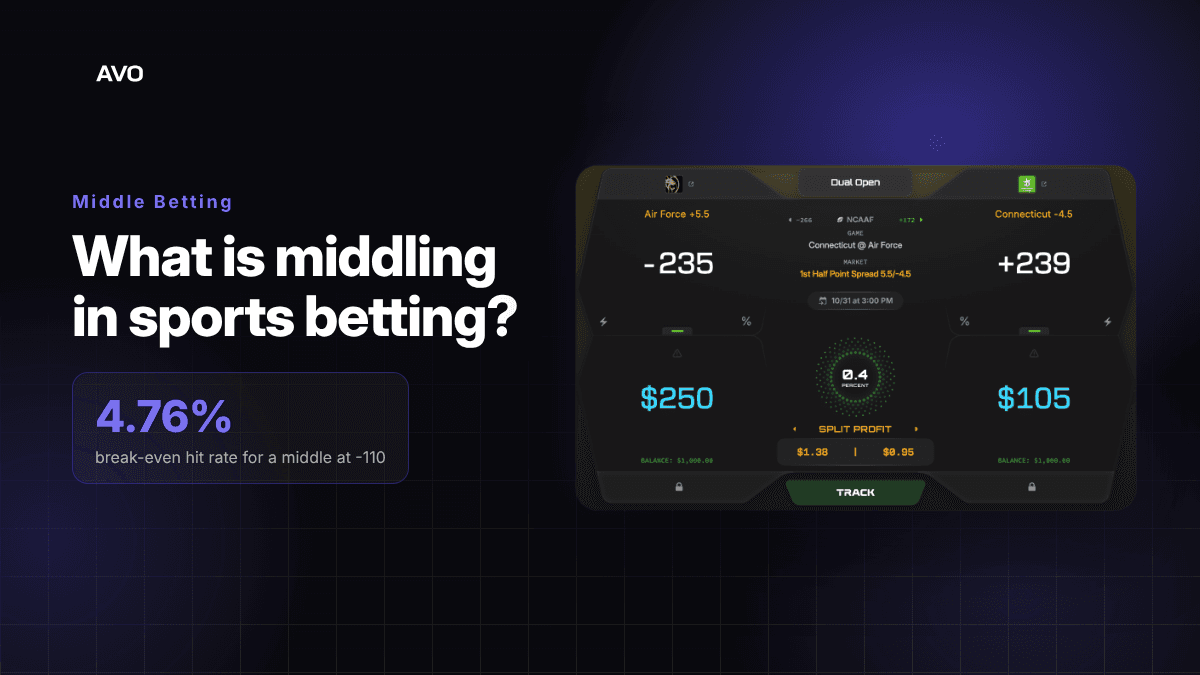
Most bets win or lose. A middle is a pair of bets that can win twice. Middle betting means betting both sides of the same game at two different lines, so that if the final score lands in the gap between them, both tickets cash. If it misses, one bet wins and the other loses, and you're usually down only a few dollars of juice.
That's the whole idea, but the details decide whether middling makes you money or slowly bleeds your bankroll. This guide explains what middling in sports betting is, walks through a full example with the math, shows how often a middle has to hit to be worth it, and covers where the best middles come from.
The short version: Middle betting is taking opposite sides of a spread, total or prop at two different numbers, for example Over 44.5 at one book and Under 46.5 at another. If the result lands in between (45 or 46), both bets win. If it doesn't, one side wins and one loses, so a miss costs you roughly the vig. A middle is profitable when it hits more often than its break-even rate, which is about 4.76% for two bets at -110.
What Is Middle Betting?
A middle happens when two sportsbooks (or the same book at two different times) offer lines on the same market that are far enough apart to leave a window between them. You bet one side at the first line and the other side at the second line.
There are three possible results:
- The middle hits. The final score lands inside the window and both bets win.
- The middle misses. The score lands outside the window. One bet wins and one loses, so you lose a small amount, usually about the vig on one bet.
- A push. If one of the lines is a whole number and the score lands exactly on it, that bet is refunded and the other bet wins. Bettors call this a half middle, and it's a nice result: you profit on one bet and get your stake back on the other.
Middles work on point spreads, totals and player props, anywhere the bet depends on a number. They don't work on a straight two-way moneyline, because there's no gap between "Team A wins" and "Team B wins". If you want the basics of how spreads are priced in the first place, Wikipedia's overview of spread betting is a good primer.
How a Middle Works: A Worked Example
Here's a classic NFL middle across the most important number in football.
- Book A has the favorite at -2.5 at -110.
- Book B has the underdog at +3.5 at -110.
You bet $110 on each side, risking $220 in total. Each bet wins $100 if it cashes.
Now look at what happens for every possible final margin:
The math behind each result:
- Favorite wins by 4 or more. The -2.5 bet wins $100. The +3.5 bet loses $110. Net: -$10.
- Favorite wins by exactly 3. The favorite covers -2.5, and the underdog covers +3.5 because it lost by less than 3.5. Both bets win: +$200.
- Favorite wins by 1 or 2, or loses the game. The -2.5 bet loses $110. The +3.5 bet wins $100. Net: -$10.
Notice what's missing: there's no result where both bets lose. Your worst case is -$10, and your best case is +$200. That lopsided payoff is the whole appeal of middling. You're paying a small, known price for a shot at a big win.
How Middles Happen
Middles come from two places: lines that move, and books that disagree.
1. The line moves after you bet. You bet a favorite at -1.5 early in the week. Injury news or sharp money pushes the line to -4.5. Now you can bet the underdog at +4.5 and you hold a middle on 2, 3 and 4. This is why it pays to bet early on numbers you like, and why reverse line movement and steam moves are worth understanding: big moves create middle windows for anyone holding a ticket on the other side.
2. Two books disagree right now. Different sportsbooks set and move lines at different speeds. At any moment, one book might hang a total at 44.5 while another still shows 46.5. You can bet both sides immediately, without waiting for anything to move. These are the middles a scanner finds, and they're the same price gaps that power line shopping and arbitrage.
3. Live betting. Lines swing hard during games. A pregame bet on a favorite at -6.5 can become a middle if the favorite jumps out early and the live line moves to -13.5, letting you take the underdog at +13.5. Live middles move fast, so they reward speed more than anything.
The Math: How Often a Middle Has to Hit
Every middle has a break-even hit rate: the share of the time it needs to land for the small losses on misses to be paid for by the occasional double win.
The formula is simple:
Break-even hit rate = Loss on a miss ÷ (Profit on a hit + Loss on a miss)
For the example above: $10 ÷ ($200 + $10) = 10 ÷ 210 = 4.76%. If that window hits more than about 1 time in 21, the middle is a +EV bet.
The juice matters a lot. Here's the break-even rate for a two-sided middle where both bets are at the same price, sized to win $100 each:
Checking each bar: at -105 you risk $105 per side, so a miss costs $5 and a hit pays $200, giving 5 ÷ 205 = 2.44%. At -108 it's 8 ÷ 208 = 3.85%. At -115 it's 15 ÷ 215 = 6.98%. At -120 it's 20 ÷ 220 = 9.09%. Shaving the juice by a few cents nearly halves the hit rate you need, which is why the best middles almost always come from finding the best price on each side.
Turning hit rate into expected value
Once you have a realistic hit rate, the expected value is easy:
EV = (Hit rate × Profit on a hit) - (Miss rate × Loss on a miss)
Take a totals middle at -110 on both sides: Over 44.5 and Under 46.5, $110 each. It hits on 45 or 46.
- If those two numbers land 6% of the time: 0.06 × $200 - 0.94 × $10 = $12.00 - $9.40 = +$2.60 per middle, about +1.2% on the $220 you put down.
- If they land only 3% of the time: 0.03 × $200 - 0.97 × $10 = $6.00 - $9.70 = -$3.70 per middle.
Same structure, opposite results. The hit rate you assume is everything, so be honest about it. If you want a refresher on expected value itself, see what EV means in betting.
Sizing a middle when the prices don't match
When the two sides have different odds, size the stakes so a miss costs the same either way. Use decimal odds:
Stake on side 2 = Stake on side 1 × Odds 1 ÷ Odds 2
Say you bet $100 on the over at -105 (decimal 1.952) and the under is -115 (decimal 1.870). Stake on the under: $100 × 1.952 ÷ 1.870 = $104.43. Each winning ticket returns $195.24. A miss costs $204.43 - $195.24 = $9.19. A hit returns $390.48 for +$186.05. Break-even: 9.19 ÷ (186.05 + 9.19) = 4.71%.
Key Numbers: Where Middles Are Worth the Most
Not every point in a window is equally likely. In the NFL, scoring comes mostly in 3s and 7s, so final margins cluster on a few key numbers.
According to a 2026 study of NFL regular-season games, about 15% of games were decided by exactly 3 points, and roughly 7% to 10% by exactly 7, depending on the period. Most other single margins land far less often. That's why a middle across 3, like the -2.5 / +3.5 example, can be worth a lot more than a middle across a number like 9 or 11, even though both windows are one point wide.
A few practical rules:
- Middles across 3 and 7 in the NFL are the most valuable. A window covering both 3 and 4, or 6 and 7, is better again.
- A wider window beats a narrower one, but only if the extra juice you pay to get it doesn't eat the gain.
- Totals have weaker key numbers. Combined scores spread across many more values than margins do, so no single total number lands anywhere near as often as a 3-point margin. Totals middles usually need two or more numbers to be worth it.
- College football and basketball spread out. Margins are more evenly distributed, so each individual number hits less often.
AVO's half point calculator shows how much a single half point is worth around key numbers, which is the same question a middle asks.
Middles on Totals, Props and Other Sports
Spreads get the attention, but middles show up everywhere there's a number.
Totals. Over 44.5 at one book, Under 46.5 at another, and a final of 45 or 46 wins both. NBA totals move a lot during the day, so two-point windows are common, but each single total number lands only rarely. Look for windows of three points or more on basketball totals.
Player props. Books disagree on props more than on main markets. Over 24.5 points at one book and Under 26.5 at another middles on 25 and 26. Player stats also cluster: passing yards, rushing attempts and points all have common landing spots. Props tend to have lower limits, so keep stakes sensible.
Other sports. Hockey and soccer totals and puck lines can be middled, but scoring is so low that windows are rare and usually only half a goal wide. Baseball run lines and totals work the same way. The math above applies to all of them; only the hit rates change.
Middle Betting vs Arbitrage
Middling and arbitrage betting look similar from the outside: both bet two sides at two books. The goal is different.
The best spots combine both. Sometimes the prices are good enough that the two sides form an arbitrage and there's a window in between: a miss still makes a small profit, and a hit makes a big one. These are rare and they disappear quickly, but they're the best bets in this whole category.
Common Middling Mistakes
Assuming every window is worth taking. A one-point middle on a basketball total at -110 on both sides is very likely -EV. Run the break-even number against a realistic hit rate before you bet.
Ignoring the juice. Taking -120 on one side to grab an extra half point can double the hit rate you need. Price matters as much as the window.
Chasing middles you can't size. If the second leg's limit is much lower than the first, you end up with a lopsided position. Check both books before you place either bet.
Betting the wrong direction. If you bet Favorite -7.5 and the line moves to -4.5, betting the underdog +4.5 doesn't make a middle. It creates a dead zone: if the favorite wins by 5, 6 or 7, both bets lose. Middles only exist when the second line moves in your favor.
Underestimating variance. Middles miss most of the time. Even a good middle at a 5% edge can go 30 or 40 bets without a hit. Size them so a long run of small losses doesn't hurt. Our guide to sports betting bankroll management shows how to set unit sizes for high-variance strategies.
Hitting the same book patterns too often. Middles often come from one book being slow to move. Repeatedly hitting stale lines is the kind of pattern that gets accounts limited. See how to avoid sportsbook limits for ways to keep accounts healthy.
How to Find Middles With AVO
Finding middles by hand means comparing every spread, total and prop across every book, then working out the window, stakes and break-even rate before the lines move. That's a lot of tabs for a bet that disappears in minutes.
AVO's middles betting tool does the scanning for you. It compares lines across 70+ sportsbooks, flags spreads, totals and props where two books leave a window between them, and loads both legs into the calculator with the stakes worked out. Dual Open, part of AVO's arbitrage tools, opens each book in its own window, already logged in, so you can place both legs before a line moves.
Try AVO Pro for 3 days for $1 →
Frequently Asked Questions
What is middling in sports betting? Middling is betting both sides of the same spread, total or prop at two different numbers. If the final result lands between them, both bets win. If it doesn't, one wins and one loses, so you usually lose about the vig on one bet.
Is middle betting profitable? It can be, but only when the middle hits more often than its break-even rate. Two bets at -110 need to hit about 4.76% of the time. Middles across key numbers like 3 and 7 in the NFL are the most likely to clear that bar.
What happens if a middle misses? One bet wins and the other loses. With both sides at -110 and $110 on each, you win $100 and lose $110, so a miss costs $10.
Can you middle a moneyline? Not a standard two-way moneyline, because there's no gap between the two outcomes. Middles need a number, so they work on spreads, totals and props.
Is middling legal? Yes. Betting both sides of a game at licensed sportsbooks is legal wherever sports betting is legal. Books can still limit accounts they see as too sharp, so spread your action out.
What is a half middle? A half middle is when one of your lines is a whole number and the result lands exactly on it. That bet pushes and refunds your stake, and the other bet wins, so you come out ahead.
AVO is an entertainment tool for adults and an analytics platform, not a sportsbook. AVO does not accept wagers and does not hold funds. You must be of legal age to bet in your jurisdiction (21+ in most states). Examples in this article are for illustration only. Please bet responsibly.

