
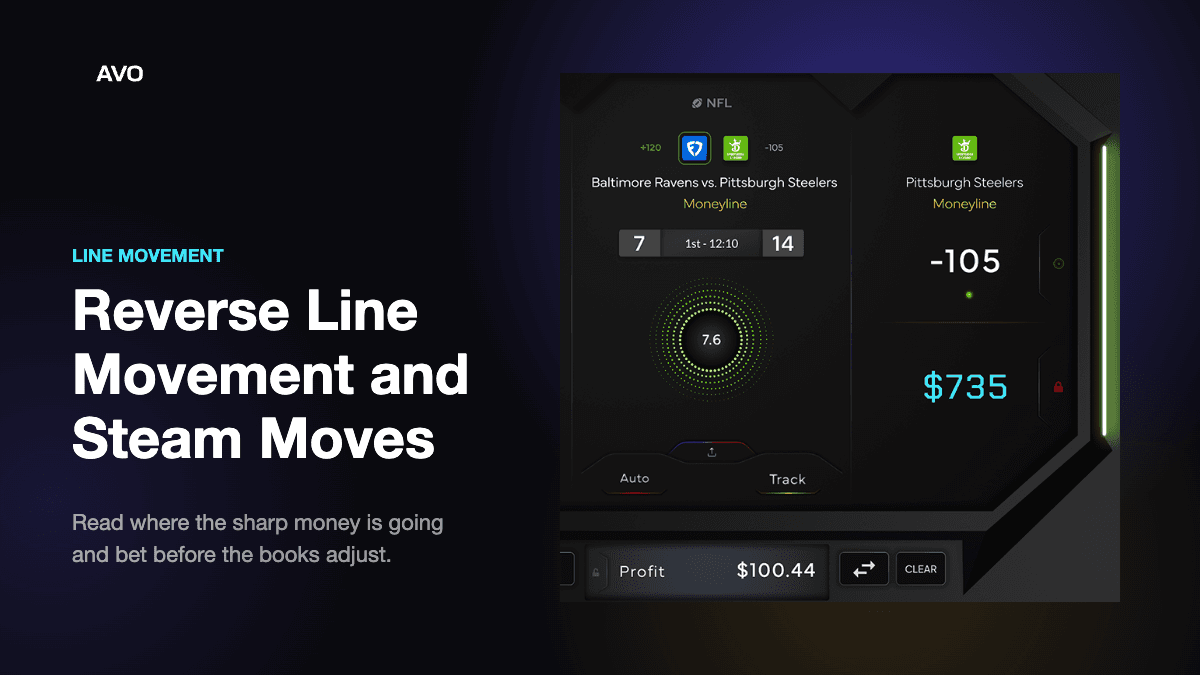
You check a game on Tuesday and 75% of the bets are on the favorite. You check again on Saturday and the favorite's line has gotten cheaper, not more expensive. That feels backwards. If almost everyone is betting one side, why would the sportsbook make that side easier to bet? The answer is reverse line movement, and it is one of the clearest signs that money you can't see is moving the market.
This guide explains what reverse line movement is, how it differs from a steam move, what causes each one, and how to use line movement without falling for the most common traps.
The short version: reverse line movement (RLM) is when a betting line moves toward the side that is getting fewer bets. It usually means a smaller number of larger, respected bets are on the other side, and the book trusts that money more than the crowd. A steam move is a sudden, fast line change across many books at once, usually triggered by sharp action. Neither one is a bet signal on its own. The edge comes from getting a price before the rest of the market catches up.
What Is Reverse Line Movement?
Reverse line movement is a line move in the opposite direction of the public betting percentage. If most tickets are on Team A but the line moves in favor of Team B bettors, that is reverse line movement.
Here is a simple NFL example:
- The Chiefs open at -3 against the Broncos.
- During the week, 70% of the bets come in on the Chiefs.
- By Sunday, the line is Chiefs -2.5.
With most of the tickets on the Chiefs, you would expect the book to move the line to -3.5 to attract Broncos money. Instead, it moved the other way and made the Chiefs cheaper. Something on the Broncos side was more convincing than 70% of the tickets.
That move from -3 to -2.5 is also a big one. More NFL games end with a 3-point margin than any other number, so a half point around 3 is worth far more than a half point around, say, 6 or 7. A book doesn't give up that half point lightly.
Why Lines Move in the First Place
To read reverse line movement, you need to know what normally moves a point spread. There are four main reasons:
- Information. Injuries, lineup news, weather and travel all change the true odds of a game, and lines adjust.
- Respected money. When bettors with a winning history place large bets, books treat those bets as information and move the line.
- Risk management. A book with heavy exposure on one side may move the line to slow that side down.
- Following the market. Most books don't build every number from scratch. When the sharp sportsbooks move, retail books move toward them.
Reverse line movement is a case where reasons 2 and 4 beat reason 3. The book has more liability on the popular side, yet it moves toward the unpopular side anyway, because it believes the smaller group of bettors knows something.
Tickets vs Handle: Reading the Betting Split
Most "public betting" numbers come in two forms, and the difference between them is where reverse line movement starts to make sense.
- Ticket percentage (bet %) is the share of individual bets on each side.
- Handle percentage (money %) is the share of the total dollars on each side.
When the two don't match, it tells you something about who is betting. Say a game takes 1,000 bets and $100,000 in handle:
- 700 tickets (70%) and $45,000 (45%) are on the Chiefs. That is an average of $45,000 / 700 = $64.29 per bet.
- 300 tickets (30%) and $55,000 (55%) are on the Broncos. That is an average of $55,000 / 300 = $183.33 per bet.
The crowd is on the Chiefs, but the bigger bets are on the Broncos. If the line then moves toward the Broncos, the split explains why. Books care about dollars and about who placed them, not about how many people agree.
One honest caveat: public betting numbers are usually from a single book or a single data source, not the whole market. They are a useful hint, not a census. Treat them as one input, never the whole read.
What Is a Steam Move?
A steam move is a sudden, sharp change in a line across many sportsbooks within a very short window, often seconds to a few minutes. It usually happens when a group of sharp bettors, or one very respected bettor, hits the same side at several books at once.
The pattern looks like this:
Steam is about speed and breadth. One book moving a line is just a line move. Several books moving the same direction, by a similar amount, at nearly the same moment, is steam. It often comes with reverse line movement, because the bettors who cause steam are frequently on the less popular side.
Reverse Line Movement vs Steam Moves
The two terms get used interchangeably, but they describe different things. Reverse line movement is about direction relative to the public. Steam is about speed and how many books move together.
- Reverse line movement: the line moves against the side with more bets. You need ticket or handle data to spot it, and it can build slowly over days.
- Steam move: the line moves fast across many books at once, usually in seconds or minutes. You can see it on an odds screen as it happens.
A move can be both. If 75% of tickets are on the favorite and the underdog suddenly steams from +4 to +3 across most books in two minutes, you are looking at steam that is also reverse line movement.
How to Spot Line Movement in Real Time
You don't need a private feed to see line movement. You need to watch the right things in the right order.
- Note the opening line. Every read starts with where the market began. A move only means something compared to the opener.
- Watch the sharp books first. Sharp books and exchanges usually move first. Retail books follow. If a sharp book moves and nobody else has, that is the early signal.
- Check how many books moved. A move at one retail book could be risk management. The same move at most books within a few minutes is steam.
- Check the news. If a starting quarterback was just ruled out, the move is information, not sharp money. That still matters, but it is a different read.
- Compare the split, if you have it. A move against a lopsided ticket count, especially with handle on the other side, is the classic reverse line movement setup.
Doing this by hand across dozens of books is slow. An odds screen puts every book's price for the same market side by side, so you can see which books moved, which haven't, and how far apart they are. AVO's odds screen covers 70+ sportsbooks.
How to Use Line Movement Without Chasing It
This is where most bettors go wrong. By the time you see that a line has moved, the books that moved are already offering the new, worse price. Betting the moved side at the moved price is not following sharp money. It is paying full price after the sale ended.
The value is at the books that haven't caught up yet. Here is the math with the steam example above.
- After the move, sharp books show Team A -140 / Team B +120.
- Implied probabilities: Team A is 140 / 240 = 58.33%, Team B is 100 / 220 = 45.45%. Together that is 103.79%.
- Removing the vig proportionally: Team A is 58.33 / 103.79 = 56.20%, a fair price of about -128.
- A slower book is still offering Team A at the old -120. A $100 bet there wins $83.33.
- Expected value = 0.5620 × $83.33 - 0.4380 × $100 = $46.84 - $43.80 = +$3.04 per $100, or about +3%.
Betting Team A at -140 after the move works out to 0.5620 × $71.43 - 0.4380 × $100 = $40.15 - $43.80 = -$3.65 per $100, because you are paying the vig on top of a fair price. Same team, same game, opposite result. You can run any market through our no-vig fair odds calculator to check this for yourself, and our guide on how to devig odds covers the methods in detail.
That is the core of positive EV betting: use the sharp market to estimate the true odds, then bet at books whose price is better than that estimate. Line movement tells you where the sharp market is heading. The stale book is where you act on it.
Closing Line Value: How to Know You Read It Right
Any single bet can lose, so wins and losses are a poor way to judge whether you read a line move correctly. Closing line value (CLV) is better. It compares the price you got to the final price before the game started.
Using the example above: you bet Team A at -120 and the line closed at -140. The closing price, devigged, says Team A had a 56.20% chance. Your -120 bet only needed 54.55% (120 / 220) to break even. You beat the close by about 1.7 percentage points of probability.
If you consistently get prices better than the close, you are betting ahead of the market, whatever happens in the short run. If you consistently get worse prices, you are chasing moves after they happen. Track it. Over a few hundred bets, CLV says more about your process than your record does. Pair it with a sensible staking plan from our bankroll management guide, since even good reads come with long losing stretches.
Common Mistakes With Line Movement
- Treating every move as sharp money. Injuries, weather and lineup news move lines too. Check the news before you read anything into a move.
- Trusting one source of betting percentages. Most public splits come from one book or one data source. They can be wrong about the wider market.
- Betting the moved price. If every book has already moved, the value is usually gone. Chasing steam at the new price is a slow way to lose to the vig.
- Fading the public by default. Betting against popular sides isn't a strategy on its own. Popular sides win plenty of games.
- Ignoring limits. Soft books notice accounts that consistently bet stale lines seconds before they move. Our guide on avoiding sportsbook limits covers how to stay active longer.
- Judging by short-term results. A correct read can lose. Judge by CLV over a large sample.
Frequently Asked Questions
What is reverse line movement in sports betting? It is when a line moves toward the side getting fewer bets. For example, 70% of bets are on the favorite but the spread drops from -3 to -2.5. It usually means larger, respected bets are on the less popular side.
What is a steam move? A sudden line change across many sportsbooks within seconds or minutes, usually caused by sharp bettors hitting the same side at several books at once.
Is reverse line movement a good betting signal? It is useful information, not a bet on its own. By the time most bettors see it, the price has already moved. The value is at books that haven't adjusted yet.
What is the difference between bet percentage and handle percentage? Bet percentage counts tickets. Handle percentage counts dollars. When most tickets are on one side but most dollars are on the other, the bigger bettors disagree with the crowd.
Can you make money chasing steam? Not by betting the price after it moves. Any edge comes from getting the old price at a slower book before it adjusts, and soft books often limit accounts that do this consistently.
How do I track line movement? Record the opening line, watch sharp books and exchanges first, and use an odds screen to compare every book's current price for the same market.
Compare odds across 70+ sportsbooks with AVO →
Try AVO Pro for 3 days for $1 →
AVO is an entertainment tool for adults and an analytics platform, not a sportsbook. AVO does not accept wagers and does not hold funds. You must be of legal age to bet in your jurisdiction (21+ in most states). Examples are illustrative, and betting involves real risk of loss. If you or someone you know has a gambling problem, call 1-800-GAMBLER. Please bet responsibly.

