
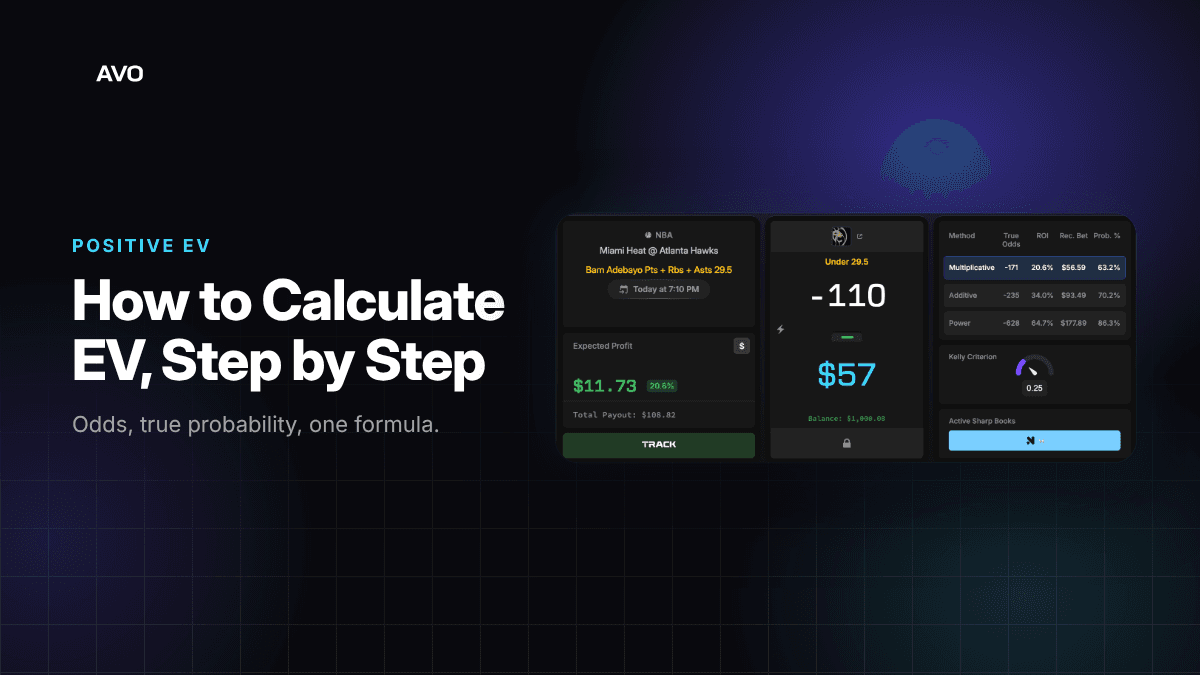
You already know a +EV bet is a good bet. The harder question is the practical one: how is EV calculated when you are staring at a real line on a real sportsbook? Where does the win probability come from, which odds do you plug in, and how do you know the answer is right?
This guide skips the definitions and works the math. We will take one bet from raw odds to a final EV number, then run the same process on favorites, longshots, bonus bets, profit boosts and parlays, so you can check any price yourself.
The short version: EV is calculated by multiplying your true win probability by the decimal odds and subtracting 1. That gives your expected profit per $1 staked. The odds come from the book you are betting at, and the true probability usually comes from removing the vig from a sharp market. If the result is above zero, the bet is +EV; below zero, it is not.
How Is EV Calculated? The Formula
Expected value is the average result of a bet if you could place it thousands of times. If you want the full concept first, read what EV means in betting. Here we only need the formula, and it comes in three equivalent forms.
All three give the same answer. Use the dollar version when you want to know what a specific stake is worth, and the percentage version when you want to compare bets against each other.
Every EV calculation needs only two inputs:
- The odds you can actually get, at the book where you would place the bet.
- The true probability of the outcome, which you have to estimate.
The first input is easy. The second is where all the skill lives.
Step 1: Convert the Odds You Are Offered
Most US books show American odds, so start by converting them into something you can multiply.
- Positive odds (+120): decimal odds = 1 + (120 ÷ 100) = 2.20. Net profit per $1 (b) = 1.20.
- Negative odds (-150): decimal odds = 1 + (100 ÷ 150) = 1.667. b = 0.667.
While you are at it, note the implied probability of the price, which is 1 ÷ decimal odds:
- +120 implies 1 ÷ 2.20 = 45.45%
- -150 implies 1 ÷ 1.667 = 60.00%
The implied probability is the break-even point. If the true chance of winning is higher than the implied probability, the bet is +EV. If it is lower, the bet loses money over time. The implied probability calculator does this conversion instantly for any price.
Step 2: Find the True Probability
This is the step most guides wave past. You cannot get a true probability from the book you are betting at, because its prices include the vig. You need a better source.
For most bettors, the best source is the market itself. Sharp books and exchanges take big bets from professionals and move their lines fast, so their prices are the closest thing to a fair number. Strip the vig out of a sharp line and you have a solid estimate of the true odds.
Here is a full walkthrough using a sharp book's moneyline of -125 / +105, and a softer book that is offering the underdog at +120.
The fair price for a 46.75% chance is about +114. The soft book is paying +120, and that gap is the entire edge. Our guide to no-vig odds covers the other devig methods (additive and power) and when they give different answers. If you want the fair line without the arithmetic, the no-vig calculator handles it.
A few rules keep this step honest:
- Devig the sharpest market you can find, not the book you are betting at.
- Use more than one sharp source when you can. If two fair prices disagree, use the more conservative one.
- Be suspicious of huge edges. A 15% edge on a main market is usually a stale line or a data error, not a gift.
Step 3: Calculate EV in Dollars and Percent
Now plug the numbers in. For the +120 underdog with a 46.75% true probability on a $100 stake:
- If it wins (46.75% of the time), you profit $120.
- If it loses (53.25% of the time), you lose $100.
EV = (0.4675 × $120) - (0.5325 × $100) = $56.10 - $53.25 = +$2.85
As a percentage, that is +2.85% of your stake. A $50 bet is worth +$1.43; a $500 bet is worth +$14.25. The percentage stays fixed, which is why bettors compare opportunities in EV % rather than dollars.
You can check any bet the same way in AVO's free EV calculator: enter the odds and your win probability, and it returns the EV in dollars and percent.
EV Examples at Different Odds
The same three steps work at any price. Here are three more bets, each on a $100 stake.
A favorite with an edge. A book offers -150, and your devigged fair probability is 62%. Decimal odds are 1.667. EV = (0.62 × 1.667) - 1 = +3.33%, or +$3.33. The price implies 60%, the true chance is 62%, and that 2-point gap is worth more than 3% because you are getting paid on a high-probability outcome.
A standard -110 line with no edge. Both sides of a spread are -110, and the fair probability is 50%. Decimal odds are 1.909. EV = (0.50 × 1.909) - 1 = -4.55%, or -$4.55. At -110 you need to win 52.38% of the time just to break even. This is the vig doing its job, and it is why most bets at a single book are -EV.
A longshot. A book offers +400 on an outcome with a fair probability of 21%. Decimal odds are 5.00. EV = (0.21 × 5.00) - 1 = +5.00%, or +$5.00. The edge looks bigger than the favorite's, but this bet loses 79% of the time. Higher EV on a longshot comes with far bigger swings, which is why stake size matters as much as the EV number. Our Kelly criterion guide shows how to size bets like this one.
EV on Bonus Bets and Profit Boosts
Promos change the formula because they change what you risk or what you win.
Bonus bets. With most US bonus bets, the stake is not returned when you win. You only keep the profit. So a $100 bonus bet at +300 with a 23.5% fair chance works like this:
- Win (23.5%): you keep $300.
- Lose (76.5%): you lose $0 of your own money.
EV = 0.235 × $300 = +$70.50. That bonus bet is worth about 70.5% of its face value, and longer odds usually convert better. Our guide on how to convert bonus bets shows how to lock that value in instead of leaving it to chance.
Profit boosts. A boost raises the payout on a bet you would otherwise pay full vig on. Say a book boosts a +150 price to +200, and the fair probability is 38%:
EV = (0.38 × $200) - (0.62 × $100) = $76 - $62 = +$14 per $100, a 14% edge.
Boosts often carry much bigger edges than regular +EV bets, but they usually come with low maximum stakes, so the dollar value per boost is small. Always check the fair probability before assuming a boost is worth it. A boost on a market with a huge built-in margin can still be -EV.
EV on a Parlay
A parlay's EV is calculated the same way, using the combined odds and the combined true probability. If the legs are independent, you multiply both.
Take the +120 underdog from earlier (46.75% fair, decimal 2.20) and add a -110 leg with a 52% fair chance (decimal 1.909):
- Combined probability = 0.4675 × 0.52 = 24.31%
- Combined decimal odds = 2.20 × 1.909 = 4.20
- EV = (0.2431 × 4.20) - 1 = +2.11%
That is lower than the +2.85% the first leg had on its own. The second leg was slightly -EV (0.52 × 1.909 - 1 = -0.73%), and it dragged the whole ticket down. A parlay is only as good as the product of its legs, so adding a -EV leg to a +EV bet makes the bet worse, not better.
Two cautions: books often price same-game parlays with extra margin, and legs from the same game are rarely independent. In those cases simple multiplication overstates your true probability.
What EV Means Over Hundreds of Bets
An EV number is an average, and averages take time to show up. Here is what our +2.85% underdog looks like as a betting habit.
Place that bet 200 times at $100:
- Expected profit: 200 × $2.85 = $571
- Typical swing (one standard deviation): about $1,550
In other words, after 200 bets a perfectly priced +EV bettor can easily be down money. The edge is real, but at 200 bets the noise is almost three times larger than the expected profit. It takes thousands of bets for EV to reliably beat variance. That is why tracking closing line value is so useful: it tells you whether your EV estimates are right long before your profit and loss does.
Common EV calculation mistakes
- Using the vigged price as the true probability. If you take a book's own -110 and call it 52.38%, every bet at that book looks break-even. You have to remove the vig first.
- Mixing up decimal odds and b. In the (p × b) - q version, b is net profit per $1. At decimal 2.20, b is 1.20, not 2.20.
- Forgetting the stake on bonus bets. If the stake is not returned, the loss side of the formula is zero, not the bonus amount.
- Trusting one sharp source blindly. One stale line can create a fake edge. Compare more than one.
- Judging a calculation by results. A +EV bet that loses was still a good bet. Check the inputs, not last night's score.
How AVO Calculates EV for You
Running these steps by hand works for one bet. Doing it for every market across every book, with prices that move every few seconds, is a job for software.
AVO's positive EV betting tool pulls odds from 103+ sportsbooks, exchanges and prediction markets, devigs the sharpest lines with several methods and flags every price that beats the fair line. Each bet shows the EV %, the fair odds, the devig methods side by side and a Kelly-based stake, so steps one through three happen automatically. You decide which bets to take.
For a quick check on a single price, the free EV calculator is the fastest way to run the formula.
Try AVO Pro for 3 days for $1 →
Frequently Asked Questions
How is EV calculated in sports betting? Multiply your true win probability by the decimal odds and subtract 1. At +120 (decimal 2.20) with a 46.75% true chance, EV = (0.4675 × 2.20) - 1 = +2.85% of your stake.
Where does the win probability come from? Most bettors use a sharp book's line with the vig removed. Convert both sides to implied probability, add them up, and divide each side by the total to get the fair probability.
What is a good EV percentage? On main markets, a steady 1% to 5% edge is strong. Anything far above that is worth double checking for a stale line or bad data before you bet.
How do you calculate EV on a bonus bet? Because the stake is usually not returned, EV is just the win probability times the profit. A $100 bonus bet at +300 with a 23.5% fair chance is worth 0.235 × $300 = $70.50.
Can a parlay be +EV? Yes, if the combined true probability times the combined decimal odds is above 1. Every -EV leg you add lowers the ticket's EV, and correlated legs make simple math unreliable.
Is there an EV calculator? Yes. AVO's free expected value calculator takes your odds and win probability and returns EV in dollars and percent. The idea itself comes from probability theory; Wikipedia's expected value page covers the math behind it.
AVO is an entertainment tool for adults and an analytics platform, not a sportsbook. AVO does not accept wagers and does not hold funds. You must be of legal age to bet in your jurisdiction (21+ in most states). Examples are illustrative, and betting involves real risk of loss. If you or someone you know has a gambling problem, call 1-800-GAMBLER. Please bet responsibly.

