
You bet $110 on a team, it wins, and you get back $210. You bet $100 on the other side of the same game somewhere else and the math is the same: risk more than you can win. That gap is not an accident. It is the vig, and understanding what the vig in betting is (and how much it quietly costs you) is one of the first things that separates casual bettors from careful ones.
This guide explains what the vig is, how the juice works on a standard bet, how to calculate it yourself, how much different markets charge, and the simple habits that let you pay less of it.
The short version: the vig (also called vigorish or juice) is the fee a sportsbook builds into its odds. On a standard -110 bet you risk $110 to win $100, so a coin flip that should pay even money pays a little less. Across both sides of a -110 / -110 market, the book keeps about 4.55% of all money wagered. You beat the vig by shopping for better prices, avoiding high-juice markets and only betting when your price beats the fair line.
What Is the Vig in Betting?
The vig is the sportsbook's commission, but you never see it as a separate line item. Instead, the book shades the odds on every side of a market so that the payouts are slightly worse than the true chances deserve. If the book gets balanced action, it pays the winners with the losers' money and keeps the difference.
The full word is vigorish. It came into English from Yiddish slang, which borrowed it from the Russian word for winnings, and it has been used for bookmakers' cuts for about a century. You can read more about the history of the term on Wikipedia.
You will hear several names for the same idea:
- Vig or vigorish: the most common term in US sports betting.
- Juice: the same thing. "Reduced juice" means a lower vig.
- Hold: the share of total money wagered the book expects to keep.
- Overround or margin: how far a market's implied probabilities add up above 100%.
They describe the same cost from slightly different angles, and the sections below show how they connect.
How the Juice Works on a -110 Bet
The easiest way to see the juice in betting is a point spread priced at -110 on both sides. A -110 price means you risk $110 to win $100.
Picture a game where each team has a true 50% chance to cover. A fair price for a coin flip is +100 on both sides: risk $100, win $100. Instead, the book offers -110 on both sides. Here is what happens if one bettor puts $110 on each team:
- The book takes in $110 + $110 = $220.
- The winning bettor gets back their $110 stake plus $100 in profit, so the book pays out $210.
- The book keeps $10 no matter who covers.
That $10 is the vig. As a share of the $220 wagered, it is $10 ÷ $220 = 4.55%. That is the hold on a standard -110 market, and it is why -110 is often called "standard juice."
From your side, the cost shows up as negative expected value. On a true coin flip at -110, your expected result per bet is 0.5 × $100 - 0.5 × $110 = -$5, or -4.55% of your $110 stake. You can win plenty of individual bets and still lose money over time if you keep paying that toll.
How to Calculate the Vig
You can work out the vig on any two-way market with nothing more than the odds. The trick is to turn each price into an implied probability and see how far the total goes above 100%.
For positive odds, the implied probability formula is 100 ÷ (odds + 100). So +130 is 100 ÷ 230 = 43.48%.
Try it on a moneyline at -150 / +130:
- -150 is 150 ÷ 250 = 60.00%.
- +130 is 100 ÷ 230 = 43.48%.
- Total: 60.00% + 43.48% = 103.48%.
- Hold: 1 - (1 ÷ 1.0348) = 3.36%.
If you would rather skip the arithmetic, our free vig calculator does it for any pair of odds.
Vig vs Hold: What the Book Actually Keeps
People use "vig" and "hold" interchangeably, but the two numbers are slightly different, and mixing them up is a common source of confusion.
- Overround is the amount the implied probabilities exceed 100%. At -110 / -110, it is 4.76%.
- Hold is the percentage of total money wagered that the book keeps when action is balanced. At -110 / -110, it is 4.55%.
The overround is always a bit larger than the hold, because it is measured against 100% while the hold is measured against everything the book took in. Hold is the number that matters for the book's business, and it is the one regulators and industry reports use.
In practice, books rarely get perfectly balanced action, so their real results swing game to game. Over thousands of bets, though, the margin does its job. Using American Gaming Association figures, Legal Sports Report estimated that US commercial sportsbooks held roughly 10.2% of handle in 2025, up from about 6.9% in 2019. That is far above the 4.55% on a single -110 bet, and a big reason is the next topic: parlays and other high-margin markets.
How Much Vig Sportsbooks Charge by Market
Not every bet carries the same juice. Main markets on popular games are the most competitive, so they tend to have the lowest vig. Smaller markets, player props and futures usually charge more.
A few patterns hold up across most US books:
- Spreads and totals on major sports usually sit at -110 / -110, a 4.55% hold, sometimes better on the biggest games.
- Moneylines often carry a similar or slightly smaller margin, but it varies more with the size of the favorite.
- Player props are frequently priced at -115 / -115 or wider, which is 6.52% or more.
- Futures with many outcomes can carry the highest margins of all, because the implied probabilities across every team often add up well above 100%.
- Three-way markets like soccer moneylines spread the vig across three outcomes. A market at +150 / +240 / +190 totals 103.89%, a 3.75% hold.
The lesson is not that props or futures are always bad bets. It is that the bar you need to clear is higher in those markets, so your edge has to be bigger to make them worth it.
Why Parlays Carry More Juice
Parlays are where the vig grows fastest, because you pay it on every leg and the costs multiply.
Take legs that are each a true 50% coin flip priced at -110. A fair two-leg parlay of coin flips should pay +300 (a 25% chance). At -110 per leg, the book pays about +264. Here is how the expected cost grows as you add legs:
- 1 leg: pays +91 vs fair +100. Expected value -4.55%.
- 2 legs: pays +264 vs fair +300. Expected value -8.88%.
- 3 legs: pays +596 vs fair +700. Expected value -13.03%.
- 4 legs: pays +1228 vs fair +1500. Expected value -16.98%.
The math for two legs: 1.9091 × 1.9091 = 3.6446 in decimal odds, or +264. EV = 0.25 × $264.46 - 0.75 × $100 = $66.12 - $75.00 = -$8.88 per $100.
Same-game parlays can be even more expensive, because books price the correlation between legs and often add extra margin on top. If you enjoy parlays, treat them as entertainment with a higher price tag, and keep them a small slice of your bankroll.
Break-Even Win Rates: What the Vig Costs You
The cleanest way to feel the cost of the juice is to look at how often you need to win just to break even. The break-even rate is simply the implied probability of the price you bet.
- At -105, you need to win 105 ÷ 205 = 51.22% of your bets.
- At -110, you need 52.38%.
- At -115, you need 53.49%.
- At -120, you need 54.55%.
Those gaps look small, but they add up. Say you make 100 bets that each win exactly half the time:
- At -110, risking $110 to win $100: 50 × $100 - 50 × $110 = -$500.
- At -105, risking $105 to win $100: 50 × $100 - 50 × $105 = -$250.
Same picks, same results, half the loss. A 5-cent difference in juice cut the cost in half. That is why serious bettors care so much about the price they get, not only the side they pick.
How to Pay Less Vig
You cannot avoid the vig entirely at a sportsbook, but you can pay a lot less of it with a few habits.
Shop every line. Different books post different prices on the same game. If one book has your side at -110 and another has it at -102, taking -102 lowers your break-even rate from 52.38% to 50.50%. Our guide to line shopping walks through how to do this quickly. An odds screen that compares 70+ sportsbooks side by side makes it a habit instead of a chore.
Look at the best price on each side. If the best price on one side is -102 at one book and the best price on the other side is -105 at another, the combined market totals 50.50% + 51.22% = 101.71%, an effective hold of just 1.69%. That is far below the 4.55% at a single -110 book.
Favor lower-margin markets. Main spreads and totals on big games usually carry less juice than props, alt lines and futures. If you bet props, make sure your edge is large enough to cover the wider margin.
Use sharper venues when you can. Some books run thinner margins than others. Our explainer on sharp and soft sportsbooks covers why. Exchanges and prediction markets work differently again: users trade against each other, so there is no traditional built-in margin, and the platform makes money in other ways. Check each platform's fees and availability in your state before you use it.
Go easy on parlays. As the section above shows, the vig compounds with every leg you add.
Using the Vig to Find Better Bets
Once you can see the vig, you can strip it out. Removing the margin from a market gives you the no-vig fair odds, the market's best estimate of each side's real chance. At -110 / -110, the fair price is +100 on both sides.
Fair odds are the benchmark for value. If a book offers a price better than the fair price, the bet has positive expected value. For example, if a sharp market's no-vig line puts a team at 50% and another book offers that team at +105, your expected value is 0.5 × $105 - 0.5 × $100 = +$2.50 per $100. Our guide on how to devig odds shows three methods for finding the fair price, and you can run any market through the no vig fair odds calculator. To learn the formula behind the edge, see what EV means in betting.
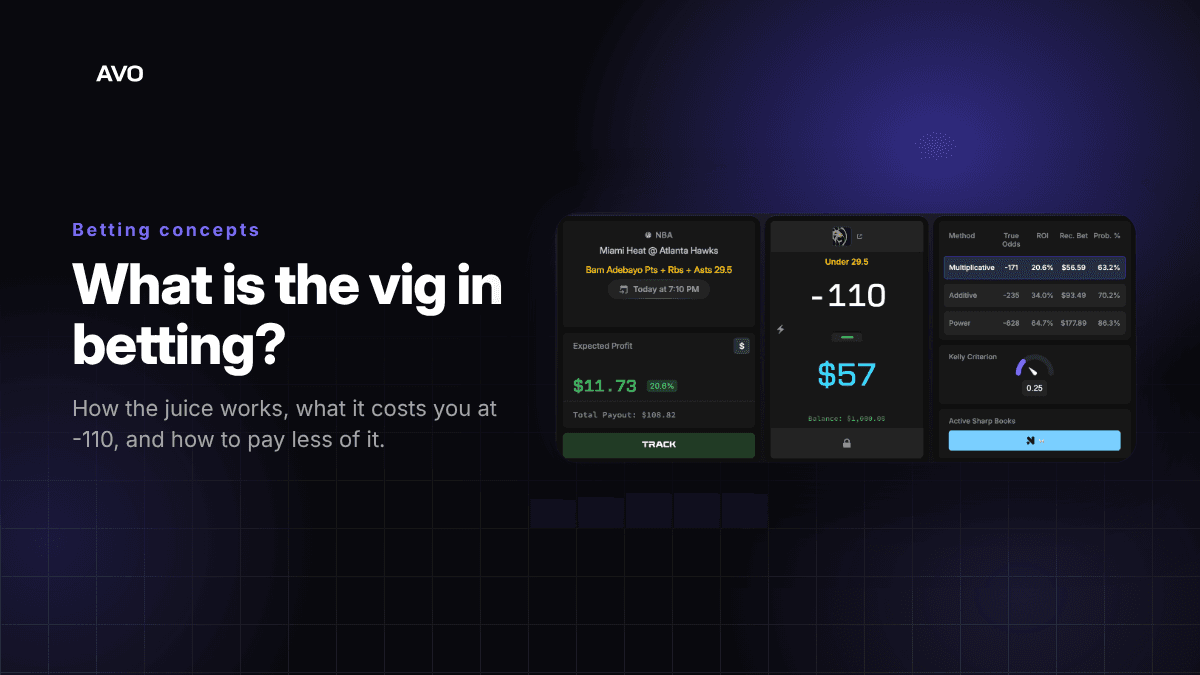
Doing this by hand works for one game. Doing it for every market across every book, many times a minute, is what software is for. AVO's positive EV betting tool devigs sharp prices in real time and flags bets where a book's price beats the fair line, across 70+ sportsbooks, exchanges and prediction markets.
Frequently Asked Questions
What does vig mean in betting? Vig, short for vigorish, is the fee a sportsbook builds into its odds. It is why you risk $110 to win $100 on a standard bet instead of risking $100 to win $100.
Is juice the same as vig? Yes. Juice, vig and vigorish all mean the same thing: the margin a book adds to its prices. "Reduced juice" means a lower vig, such as -105 instead of -110.
How do you calculate the vig on a bet? Convert both sides to implied probability, add them up and subtract 100%. For -110 / -110, that is 52.38% + 52.38% = 104.76%, so the overround is 4.76% and the hold is 4.55%.
Do you pay vig if you win? You pay it on every bet, win or lose, because it is built into the price. When you win at -110, you collect $100 on a $110 stake instead of $110, so the vig comes out of your winnings.
What is a good vig in sports betting? Anything under about 4.55% (the hold at -110 / -110) is better than standard. Reduced-juice prices like -105 / -105 carry a hold of 2.38%. Props and futures often run 6% or higher.
Can you avoid the vig completely? Not at a traditional sportsbook, but you can shrink it by line shopping, favoring lower-margin markets and avoiding long parlays. Exchanges and prediction markets do not build a traditional margin into prices, though they may charge fees.
Try AVO Pro for 3 days for $1 →
AVO is an entertainment tool for adults and an analytics platform, not a sportsbook. AVO does not accept wagers and does not hold funds. You must be of legal age to bet in your jurisdiction (21+ in most states). Examples are illustrative, and betting involves real risk of loss. If you or someone you know has a gambling problem, call 1-800-GAMBLER. Please bet responsibly.

