
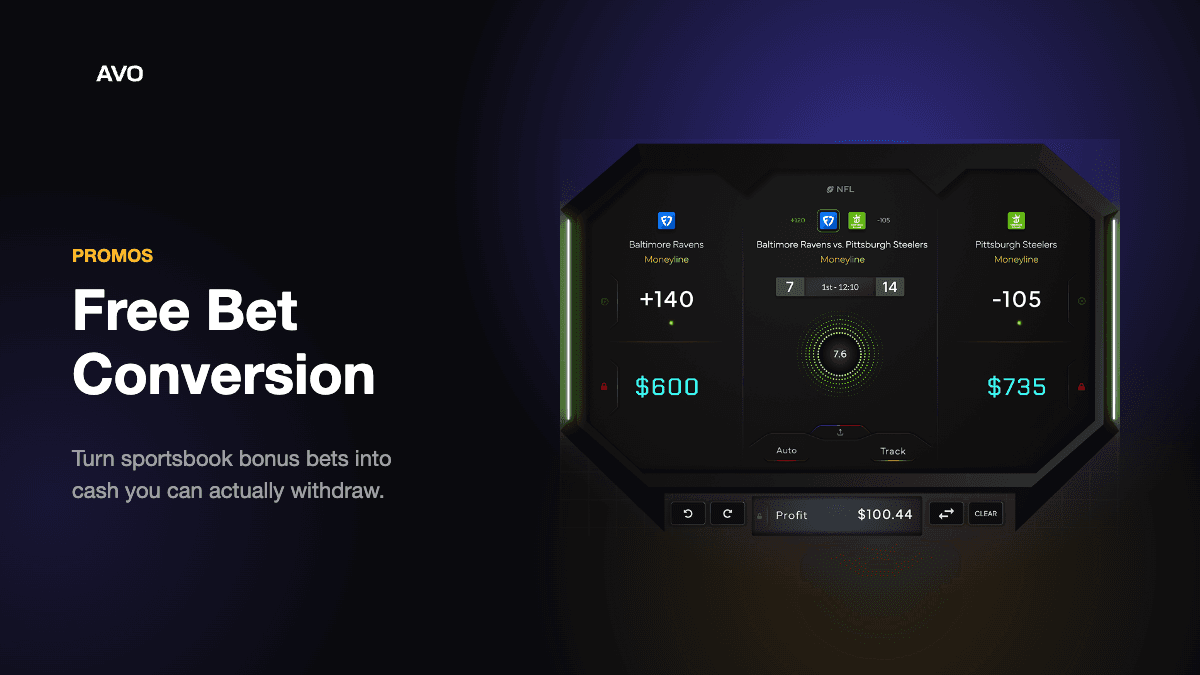
You signed up for a sportsbook, placed your first bet and got $200 in bonus bets. It looks like $200, but you can't withdraw it, it expires in about a week, and if you use it the way most people do, you'll probably end up with nothing. Free bet conversion is the method sharp bettors use to turn that credit into real, withdrawable cash, with a known result before the game even starts.
This guide covers how free bet conversion works, the simple formula behind it, a full worked example, which odds convert best, what rate to expect, and the mistakes that quietly cost people money.
The short version: Free bet conversion means placing your bonus bet on one side of a market at one sportsbook and hedging the other side with cash at a different sportsbook, sized so you profit the same amount whoever wins. Because a bonus bet only pays the winnings, not the stake, you want longer odds on the bonus side, usually around +300 to +600. Done well, you keep roughly 65% to 75% of the bonus as cash.
What Is Free Bet Conversion?
Free bet conversion (also called bonus bet conversion) is the process of turning sportsbook bonus bets into cash you can withdraw. US sportsbooks mostly call them "bonus bets" now, but the idea is the same as the "free bets" you'll see in older guides.
It works by covering every outcome of a game:
- Place the bonus bet on one side at Sportsbook A.
- Place a cash bet on the other side at Sportsbook B.
- Size the cash bet so your profit is about the same whichever side wins.
One side always wins, so one of your two bets always pays. The bonus bet itself costs you no cash, so the hedge turns it into a fixed amount of real money. It's the same idea behind hedging a bet, applied to sportsbook promos, and it's the core move in what's known outside the US as matched betting.
Why a Bonus Bet Is Worth Less Than Cash
The catch with bonus bets is in the fine print: the stake is not returned. When a $100 cash bet at even money wins, you get $200 back: your $100 stake plus $100 profit. When a $100 bonus bet at even money wins, you get just the $100 in winnings.
That changes the math completely:
- A $100 bonus bet at -110 pays only $90.91 if it wins, and nothing if it loses.
- The same bet at +400 pays $400 if it wins.
On a short favorite, most of the value of the bonus disappears. That's why using a bonus bet on a -200 favorite "because it's safe" is one of the worst ways to use it: it wins often, but it pays only $50.
Bonus bets also come with rules that cash doesn't have. At major US books they usually expire about 7 days after you get them, each one generally has to be placed as a single wager, and some offers carry minimum odds. Always check the terms on your specific offer.
The Free Bet Conversion Formula
You only need two numbers: the bonus side's odds and the hedge side's odds, both in decimal. (To convert American odds: +400 is 1 + 400 ÷ 100 = 5.00, and -475 is 1 + 100 ÷ 475 = 1.2105.)
The first formula takes the bonus bet's potential winnings and divides by the hedge odds. That gives you the cash stake that pays back the same amount if the hedge side wins. The second tells you how much of the bonus you actually kept. That percentage is the number to compare between options.
You don't have to do this by hand. AVO's free bet conversion calculator takes the bonus amount and both prices and gives you the hedge stake, locked-in profit and conversion rate.
A Worked Example: Converting a $100 Bonus Bet
You have a $100 bonus bet at Sportsbook A. You find an NBA game where:
- Sportsbook A has the underdog at +400 (decimal 5.00).
- Sportsbook B has the favorite at -475 (decimal 1.2105).
Step 1: Work out the bonus bet's winnings. $100 × (5.00 − 1) = $400.
Step 2: Size the hedge. $400 ÷ 1.2105 = $330.43 in cash on the favorite at Sportsbook B.
Step 3: Check both outcomes.
| Outcome | Bonus bet (Book A) | Cash hedge (Book B) | Net cash profit |
|---|---|---|---|
| Underdog wins | +$400.00 | −$330.43 | +$69.57 |
| Favorite wins | $0 (bonus lost) | +$69.57 | +$69.57 |
Either way, you finish $69.57 ahead in real money. That's a 69.6% conversion rate on a bonus that couldn't be withdrawn on its own.
On the hedge side, $330.43 at -475 wins $330.43 × (100 ÷ 475) = $69.57, which matches. If you round the hedge to a clean $330, the results become +$70.00 and +$69.47, close enough and less likely to look automated.
Compare that to the "safe" approach of putting the same $100 bonus on a -110 favorite with no hedge. You'd win $90.91 a bit more than half the time and get nothing the rest, and you'd have no idea which until the game ended.
Why Longer Odds Convert Better (Up to a Point)
Because the bonus stake isn't returned, the bonus bet is worth the most when its winnings are large compared to its stake. That's why you put the bonus on the underdog and the cash on the favorite.
But longer isn't always better. The two prices you combine always have some sportsbook margin built in, and on very long odds the hedge stake gets so large that the margin eats into your return. Here's what happens if every pair carries the same 3% combined margin (the two implied probabilities add up to 103%):
Two takeaways:
- The sweet spot is usually around +300 to +600. That's where the stake penalty is small and the margin hasn't taken over yet.
- The margin matters as much as the price. The worked example above had a margin of only 2.6%, which is why it beat the chart's +400 figure. Finding the tightest pair across many books is where most of your extra conversion comes from. That's the same skill as line shopping, aimed at promos.
Longer odds also need more cash on the hedge. A $100 bonus at +400 needed about $330 of cash. At +1000, you'd need over $900. Make sure you have the cash at the hedge book before you place the bonus bet.
What Conversion Rate Should You Expect?
For standard bonus bets, a realistic target is about 65% to 75%:
- Below 60%: usually a sign you used too short a price, or a pair with a wide margin.
- 65% to 75%: good, and where most careful conversions land.
- Above 75%: possible when two books disagree on a price, but it doesn't come along every day.
So $200 in bonus bets typically turns into about $130 to $150 in cash. That's not $200, but it's a lot more than the zero many people end up with by using bonus bets on parlays or heavy favorites.
Your rate also depends on timing. More games mean more pairs to choose from, so a busy NFL Sunday or a full NBA and NHL slate usually beats a quiet Tuesday morning. Plan around expiry dates so you aren't forced to use a bonus on a thin slate.
Converting No-Sweat Bets, Deposit Matches and Other Promos
Not every promo arrives as a simple bonus bet, but most end up as one.
- "Bet $5, get $200 in bonus bets." These usually pay out as several smaller bonus bets. Convert each one separately with the same method. Smaller tokens give you more flexibility to spread across games.
- No-sweat or second-chance bets. If your first cash bet loses, the book refunds it as a bonus bet. The refund is worth roughly its conversion rate, so a $50 refund converted at 70% is worth about $35 in cash. Some bettors also hedge the original cash bet at another book to lock in a smaller but more predictable result.
- Deposit matches paid as bonus bets. Same as above once the bonus bets land. Read the terms first, since some deposit offers come with rollover requirements that work differently.
- Profit boosts. These are a different animal. A boost raises the payout on a cash bet, so the question is whether the boosted price beats a fair price. That's positive EV betting territory rather than conversion.
Mistakes That Cost You Money
Free bet conversion is simple math, but small errors can turn a locked profit into a loss.
- Picking a market that can push or tie. If the game can tie (a soccer moneyline, a whole-number spread or total), your bonus bet may be voided while your hedge loses. Stick to two-way markets: MLB, NBA or NHL moneylines, or spreads and totals with a half point.
- Betting both sides at the same book. The hedge must be at a different sportsbook. Betting both sides at one book is pointless and likely breaks the terms.
- Ignoring max bet limits on the hedge. Check that the hedge book will accept your full stake at that price before placing the bonus bet.
- Letting the price move. Place the bonus bet first, then the hedge right away. If the hedge price moves while you wait, recalculate before you bet.
- Hedging to the cent every time. Exact hedge amounts like $330.43 are a classic sign of hedging. Rounding to whole dollars costs almost nothing.
- Missing the expiry. An unused bonus bet is worth exactly $0. Convert them early in the week they arrive.
- Using obscure props. Thin markets often have wide margins and low limits, and outlier prices draw attention. Our guide to avoiding sportsbook limits covers how to keep accounts healthy longer.
It also helps to hold accounts at plenty of books, so there's always a good hedge partner available. Our guide to the best sportsbooks for arbitrage betting is a good checklist, since the same books that are useful for arbitrage are useful for promo conversion.
How to Convert Bonus Bets Faster With AVO
The slow part of free bet conversion isn't the math. It's finding the best pair: checking every underdog price at the book holding your bonus, then hunting for the best opposite price across every other book you have, before the lines move.
AVO's bonus bet converter does that search for you. It scans 70+ sportsbooks, pairs the book holding your bonus with the best opposing price elsewhere, sizes the hedge and shows exactly what to place on each side and what you keep. With Dual Open, you can open both books at once and place both bets in seconds.
If you just want to check a pair you've already found, the free bet calculator handles a single conversion.
Convert your bonus bets with AVO →
Try AVO Pro for 3 days for $1 →
Frequently Asked Questions
Can you cash out bonus bets? Not directly. Bonus bets can't be withdrawn, and the stake isn't returned when they win. Free bet conversion is how you turn them into cash: place the bonus bet on one side, hedge the other side with cash at a different book, and you keep the same profit either way.
What odds should I use for a bonus bet? Usually somewhere around +300 to +600 on the bonus side, hedged on the favorite at another book. Very short odds waste most of the bonus, and very long odds need a large hedge where the margin eats into your return.
What is a good bonus bet conversion rate? About 65% to 75% is a realistic target. That means a $100 bonus bet should usually become $65 to $75 in cash. Anything above 75% is a strong find.
Is free bet conversion legal? Yes. You're placing ordinary bets at licensed sportsbooks with promos they chose to offer. Sportsbooks can still limit accounts they see as promo-focused, so spread your activity sensibly.
Do I need two sportsbooks to convert a bonus bet? Yes. The bonus bet goes on one book and the cash hedge on another. Betting both sides at the same book doesn't work.
How long do I have to use my bonus bets? At major US sportsbooks, bonus bets commonly expire about 7 days after they're issued, but it varies by book and offer. Check your account's promo terms and convert them before they lapse.
AVO is an entertainment tool for adults and an analytics platform, not a sportsbook. AVO does not accept wagers and does not hold funds. You must be of legal age to bet in your jurisdiction (21+ in most states). Examples in this article are for illustration only; real odds, limits and promo terms vary by sportsbook. Please bet responsibly.

