
Every bet at a regular sportsbook comes with two problems baked in. The book charges a margin on both sides of the line, and if you start winning, it can cut your limits to a few dollars. A sports betting exchange removes both problems at once. You trade against other bettors instead of the house, the platform takes a small fee instead of a margin, and it has no reason to care whether you win.
For years that model mostly lived in the UK. In 2026 it finally arrived in the US at scale, and it changed how serious bettors build their accounts. This guide covers how a sports betting exchange works, which ones are live in the US right now, what they charge, and how to use one alongside your sportsbooks.
The short version: a sports betting exchange matches you with another bettor who takes the other side, and charges a small fee or nothing instead of building a margin into the odds. In the US, Novig and ProphetX are the two main sports exchanges, both regulated by the CFTC since June 2026 and available in most states. Prices are often close to fair, and exchanges have no reason to limit winners, which makes them a strong leg for arbitrage and line shopping. Availability and fees change often, so confirm both in the app before you fund an account.
What Is a Sports Betting Exchange?
A sports betting exchange is a marketplace where bettors set and take prices from each other. The exchange does not take the other side of your bet. It holds an order book, matches a buyer with a seller and collects a fee on the trade or on the winnings.
That one difference changes the incentives. A sportsbook makes money when its customers lose, so it builds a margin into every line and limits the people who beat it. An exchange makes money on volume. A winning bettor who trades a lot is a good customer, not a risk to manage.
Most US exchanges now present this as buying a side, not "backing" or "laying" like the classic UK model. You pick a team, you see a price, and you either take the best price on offer or post your own and wait for someone to match it. Under the hood, every matched bet has a real person on the other end.
How a Betting Exchange Works
Think of an exchange as a stock market for one game. On each side of a market there is a stack of open offers at different prices, and the best ones sit at the top.
- Taking a price: you accept an offer that is already on the board. Your bet fills right away. On most US exchanges, this is the side that pays a fee, if there is one.
- Making a price: you post your own odds, for example +105 on a team that is currently +100. Your offer sits in the book until another bettor takes it. Makers usually pay less or nothing, and some platforms pay makers a small credit for adding liquidity.
- Liquidity: how much money is waiting at each price. Big markets like NFL sides and totals often have deep books. A third-quarter player prop might have only a few hundred dollars available at the best price, and the next price down can be much worse.
Because prices come from bettors competing with each other, the two sides of a popular market usually add up to something very close to 100% implied probability. That is the core appeal. At a typical sportsbook, a -110 / -110 line carries about a 4.5% margin. On an exchange, a busy market might be -102 / +100 or tighter.
Sports Betting Exchanges in the US Right Now
The US exchange landscape moved more in 2026 than in the previous five years. Here is where the main platforms stand as of November 3, 2026.
Novig. Novig started as a sweepstakes-style exchange, received CFTC approval as a designated contract market in June 2026 and relaunched as a real-money exchange in August. It is 21+ and live in most states, with a handful excluded (Nevada among them). It is by far the busiest US sports exchange by volume. Pregame straight trades carry no fee, live trades carry a small taker fee, and makers can earn credits.
ProphetX. ProphetX also received CFTC approval in June 2026 and launched real-money sports contracts days later. It charges roughly 2% of net winnings on straight trades. It is available in most states outside Nevada, though it stopped offering sports contracts in Connecticut in October after pushback from state regulators.
Sporttrade. Sporttrade ran a state-licensed betting exchange in New Jersey and four other states, then shut it down in mid-2026 to rebuild as a federally regulated prediction market. It has applied to the CFTC and is taking waitlist sign-ups, but at the time of writing we could not find a public record of approval or a relaunch date.
Kalshi and Polymarket US. These are prediction markets, not sports-first exchanges, but they list contracts on the same games and work the same way under the hood: an order book, peer-set prices and a trading fee instead of a margin. Kalshi is the largest. Polymarket US is the CFTC-regulated version of Polymarket for American users. Our guide to prediction market arbitrage covers how these price differently from sportsbooks.
Things are still moving fast. Several states have challenged these platforms over sports contracts, and court fights are ongoing. Always check the platform's own state list and fee page before you deposit.
Are Betting Exchanges Legal in the US?
The short answer is that it depends on the platform's license and where you live, and the rules are still being argued in court.
State-licensed exchanges are legal in the states that license them, but that model has struggled to scale. Sporttrade's exit is the clearest example: separate licenses, taxes and compliance costs in every state made a low-fee product hard to run.
The bigger shift came from federal regulation. Novig, ProphetX, Kalshi and Polymarket US operate as designated contract markets overseen by the Commodity Futures Trading Commission. They treat a game as an event contract that settles at $1 or $0, which is how they offer sports markets in states with no legal sportsbook at all.
Several state regulators disagree with that view and have sent cease-and-desist letters or sued, and some federal courts have sided with the exchanges. For a bettor, the practical rule is simple: if the platform lets you sign up and verify in your state, it is offering service there, and if it pulls out, it will tell you and let you withdraw. For the betting side of the legal picture, see is arbitrage betting legal.
Betting Exchange Fees, Explained With Real Math
Exchange fees look tiny next to a sportsbook's margin, but they still change your numbers, so it pays to do the math once.
Take a $100 bet at even money (+100).
- Sportsbook at -110: a win pays $90.91. The extra $9.09 you would get at a fair price is the book's cut.
- Exchange at +100 with 2% of net winnings: a win pays $100, minus a $2 fee, so you keep $98. That is the same as betting at -102.
- Exchange at +100 with no fee on the trade: a win pays the full $100.
On a single bet, the gap between $90.91 and $98 is $7.09. Over a season of a few hundred bets, that is the difference between needing a big edge to break even and needing almost none. This is the same idea covered in our guide to what the vig is: the less you pay to place a bet, the less skill you need to profit.
A few fee habits worth building:
- Read the fee as a percentage of the payout, then convert it to an effective price.
- Check whether the fee applies to winnings, to every trade, or only when you take a price.
- Recheck after any announcement. US exchanges changed their fee schedules several times in October 2026 alone.
Why Exchanges Matter for Arbitrage
Arbitrage needs two things: a gap between two prices, and accounts that stay open long enough to bet it. Exchanges help with both.
Exchanges are often the sharpest or one of the sharpest prices in a market, so they are a common partner for a soft sportsbook that is slow to move. And because an exchange has no reason to limit winners, it is the leg that stays open after your sportsbook accounts get cut. That is why our guide to the best sportsbooks for arbitrage betting treats an exchange account as a core part of the portfolio, not an extra.
Here is a worked example. Fanatics has Team A at +115. An exchange has Team B at -105. You have $1,000 to split.
The fee did not kill the arb, but it took about a quarter of the profit. If you ignore it, your stakes will be slightly off and one side will pay less than the other. Always enter the exchange's effective price, after fees, when you size an arb.
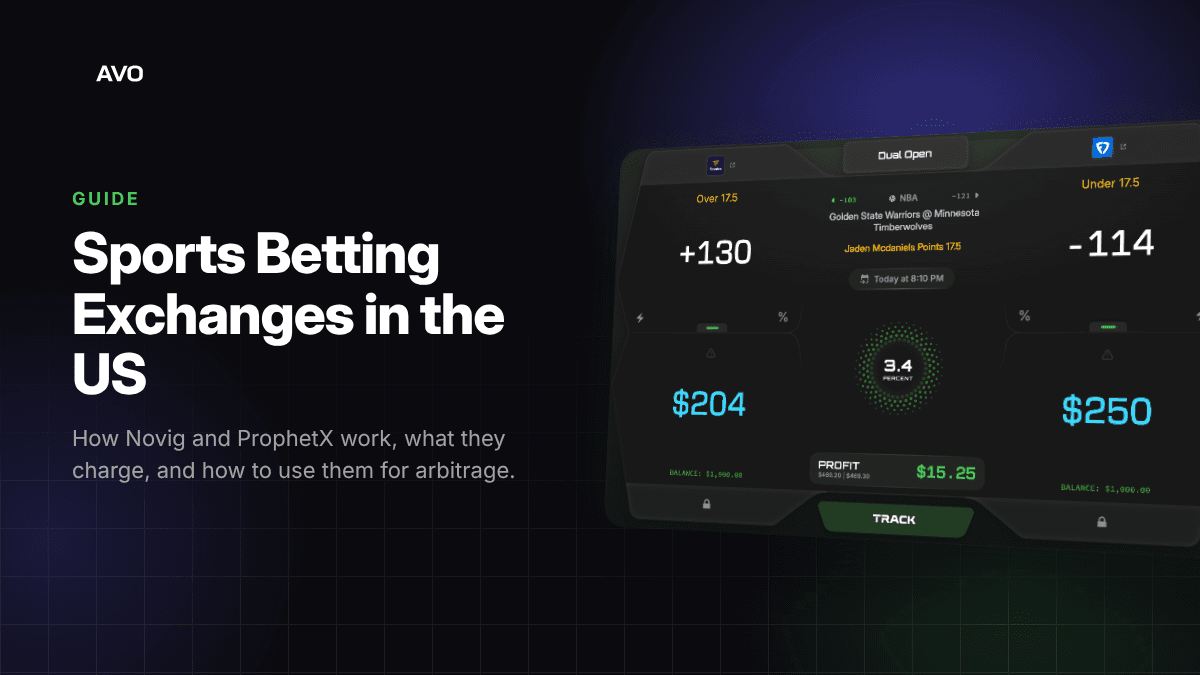
AVO's arbitrage betting tool scans 70+ sportsbooks, exchanges and prediction markets for gaps like this one and calculates the stakes for you. With Dual Open, you can open both legs side by side so you place them in seconds, before the price moves.
Using an Exchange for +EV Betting and Line Shopping
You don't need an arb to get value from an exchange. Two everyday uses:
As a price to beat. In busy markets, an exchange's best prices are close to fair odds, because there is almost no margin in them. If a sportsbook is offering a better price than the exchange's fair line, that is often a positive EV bet. It's the same idea as using a sharp sportsbook as your reference, and AVO's positive EV betting tool uses exchange and sharp book prices this way when it devigs a market.
As one more book to shop. For your normal bets, an exchange is simply another line to compare. On a busy side, the exchange price will often beat every sportsbook's -110. If you want to check a fair price yourself, the no-vig fair odds calculator strips the margin out of any two-sided line.
Post your price when you can wait. If the best available price is +100 and you think +105 is fair, post +105 as a maker. You may get filled, you may not, but you will never pay a taker fee for the bets that do fill.
Risks and Downsides to Know
Exchanges are not a free lunch. Know these before you move money:
- Thin liquidity. The best price might only be good for $150. Larger stakes walk down the book to worse prices. Check the depth before you treat a price as real.
- Fewer markets. If no one posts a price, there is no market. Niche props, small leagues and live markets can be thin or empty.
- Changing rules and fees. Fee schedules, promos and market lists change often. Something true last month may not be true today.
- State availability. A platform can leave a state after a regulatory challenge. Keep withdrawals regular and don't park more than you need.
- Settlement and voids. Read how the platform handles postponed games and obvious price errors. Some keep the right to cancel trades far from fair value.
None of these are reasons to skip exchanges. They are reasons to treat each one as a tool with its own rules, and to size bets with care, which our bankroll management guide covers in detail.
How to Get Started With a Sports Betting Exchange
- Check your state. Open the platform's help center and confirm it serves your state and your age (21+ on Novig).
- Verify early. ID checks can take a day. Do it before you need the account for a live arb.
- Fund a modest amount. Start with what you would put in one sportsbook, then add more once withdrawals have gone smoothly.
- Read the fee page. Note which trades carry no fee, which pay a taker fee and how fees appear on the quote screen.
- Place a small test trade. Take a price, then post one as a maker, so you understand fills before real money is on the line.
- Add it to your scanner. Make sure your odds tool includes the exchange, so you see it in every comparison.
If you want a ready-made view of where exchange prices beat or trail the sportsbooks, AVO does that comparison across 70+ sportsbooks in one screen.
Try AVO Pro for 3 days for $1 →
Frequently Asked Questions
What is a sports betting exchange? It is a platform where bettors trade against each other instead of against a sportsbook. The exchange matches the two sides and charges a small fee or nothing, instead of building a margin into the odds.
Is there a sports betting exchange in the US? Yes. Novig and ProphetX are the two main US sports exchanges. Both received CFTC approval in June 2026 and are available in most states. Kalshi and Polymarket US also offer sports contracts with exchange-style pricing.
Do betting exchanges limit winning bettors? Exchanges make money on volume, not on customer losses, so they have no structural reason to limit winners. That is one of the main reasons bettors use them.
How do betting exchanges make money? They charge fees, either a percentage of net winnings (around 2% on ProphetX straight trades) or a small fee when you take a price. Novig charges nothing on pregame straight trades.
Is Sporttrade still open? Sporttrade closed its state-licensed exchange in mid-2026 and is working on a relaunch as a CFTC-regulated prediction market. At the time of writing, it had not relaunched.
Can I use a betting exchange for arbitrage? Yes, and exchanges are one of the best arbitrage legs because their prices are tight and accounts stay open. Just use the price after fees when you calculate your stakes.
AVO is an entertainment tool for adults and an analytics platform, not a sportsbook. AVO does not accept wagers and does not hold funds. You must be of legal age to bet in your jurisdiction (21+ in most states). Platform availability, fees and rules were checked on November 3, 2026 and change often, so confirm them with each platform. Examples are illustrative, and betting involves real risk of loss. If you or someone you know has a gambling problem, call 1-800-GAMBLER. Please bet responsibly.

