
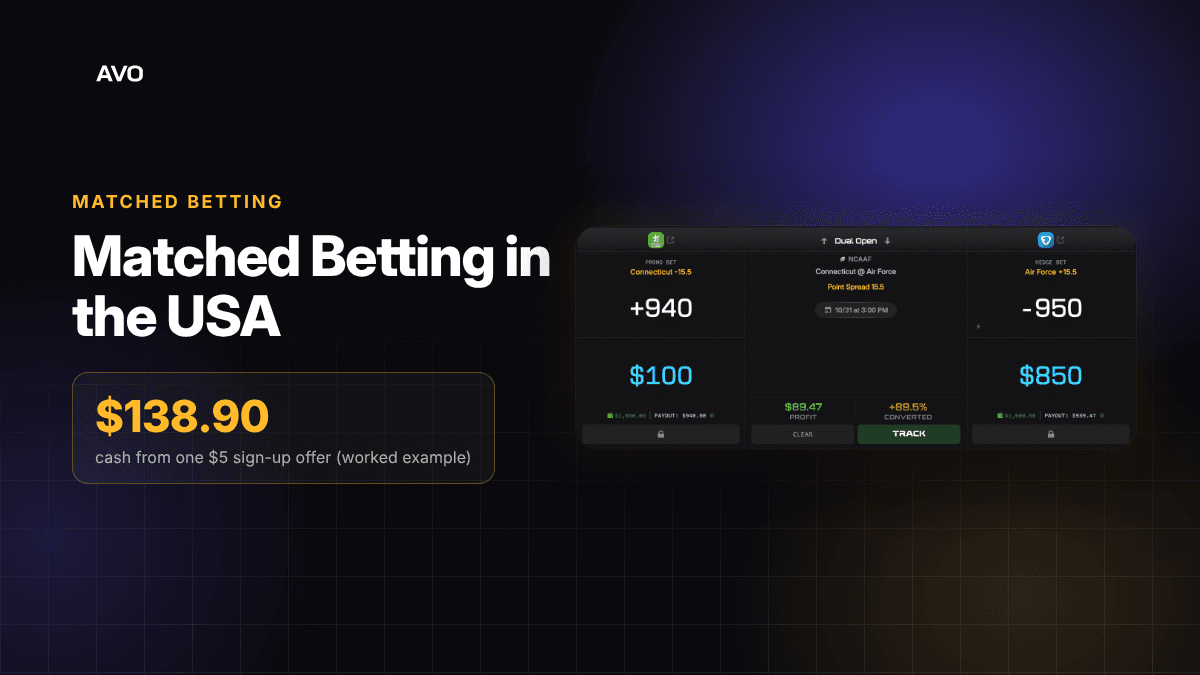
Every legal US sportsbook wants your account, and they pay for it with sign-up offers, bonus bets and no-sweat bets. Most people use those promos like lottery tickets and walk away with nothing. Matched betting in the USA is the opposite approach: you cover every outcome of a bet so the promo turns into a predictable amount of cash, whoever wins the game.
The method is famous in the UK, where it runs on betting exchanges. The US doesn't have the same exchange setup, so the playbook looks a little different here. This guide covers how matched betting works in the US, the promos worth matching, a full worked example with real math, what you can realistically make, and the risks nobody mentions in the hype videos.
The short version: Matched betting means betting both sides of a market at two different sportsbooks so a promo, not the game result, decides your profit. In the US you "match" by betting the opposite side at a second sportsbook instead of laying it on an exchange. A typical "bet $5, get $200 in bonus bets" offer can turn into roughly $130 to $150 in cash once the bonus bets are converted. It's legal in states with legal sports betting, but sportsbooks can and do limit promo-focused accounts.
What Is Matched Betting?
Matched betting is a way of using sportsbook promotions to lock in a profit by betting on every possible outcome of an event. One of your bets always wins, so the result of the game stops mattering. What's left is the value of the promo.
Every matched bet has two halves:
- The promo bet. A bet at the sportsbook offering the promo, either a qualifying cash bet or a bonus bet.
- The matching bet. A bet on the opposite outcome somewhere else, sized so you finish with about the same result either way.
The idea started in the UK in the 2000s, where bettors back a selection at a bookmaker and "lay" it (bet against it) on an exchange like Betfair. You can read the background on Wikipedia's matched betting page. The math transfers directly to the US. The tools you match with are what change.
How Matched Betting Works in the USA
The big difference between UK and US matched betting is the matching side. In the UK, you lay the bet on an exchange. In most US states, there isn't a liquid lay exchange, so you match by betting the other side at a second sportsbook.
That works because most US promos are on two-way markets: moneylines in the NBA, NHL and MLB, or spreads and totals with a half point. If you bet Team A at one book and Team B at another, you've covered every outcome, just like a back and lay.
A few US-specific rules shape how it works:
- Bonus bets don't return the stake. A $100 bonus bet at +100 pays $100, not $200. This one rule drives most of the strategy, because it means the bonus is worth far more on longer odds.
- Bonus bets expire fast. At big books like DraftKings and FanDuel, bonus bets generally expire 7 days after they're issued. Terms vary by book and offer, so check yours.
- You need several funded accounts. Your matching bet is placed at a different sportsbook, so you need cash sitting at more than one book.
- State matters. Which books you can use depends on where you are physically located when you bet.
Matched betting in the US is basically two moves repeated across many offers: get the promo with as little loss as possible, then turn the bonus bets it pays into cash.
The Promos You Can Match
Not all promos are worth the same. Here are the main types you'll see at US sportsbooks, roughly in order of value.
- "Bet $5, get bonus bets" sign-up offers. You place a small qualifying bet and receive a few hundred dollars in bonus bets, sometimes win or lose, sometimes only if you win. These are the best value in matched betting because the cost to qualify is tiny.
- Deposit matches. The book matches your first deposit, usually paid as bonus bets. Read the terms closely, since some carry rollover or playthrough rules that change the math.
- No-sweat, first bet or second-chance bets. If your first cash bet loses, the book refunds it as a bonus bet. You can match these too, with a bit more planning (see the example below).
- Ongoing reload promos. Weekly bonus bets, "bet and get" offers on big games and no-sweat bets for existing customers. Smaller, but they keep coming after the sign-up offer is used.
- Profit and odds boosts. Only worth matching when the boosted price beats a fair price, which is closer to positive EV betting than classic matched betting.
Start with the sign-up offers at the books you don't have accounts with yet. That's where most of the money is.
A Worked Example: Matching a "Bet $5, Get $200" Offer
Here's a full matched betting run on a hypothetical offer: bet $5, get $200 in bonus bets, win or lose, paid as four $50 bonus bets. All prices are for illustration.
Step 1: The qualifying bet. You bet $5 on Team A at -110 at Sportsbook A. At Sportsbook B you bet Team B at +100. To match, the hedge stake is $5 × 1.9091 ÷ 2.00 = $4.77.
| Outcome | Sportsbook A ($5 at -110) | Sportsbook B ($4.77 at +100) | Net |
|---|---|---|---|
| Team A wins | +$4.55 | −$4.77 | −$0.23 |
| Team B wins | −$5.00 | +$4.77 | −$0.23 |
You lose about 23 cents either way. That's the qualifying loss, the cost of unlocking the offer.
Step 2: Convert the bonus bets. Now you have four $50 bonus bets. Take the first one and put it on an underdog at +400 at Sportsbook A, then hedge the favorite at -475 at Sportsbook B.
- Bonus winnings if it hits: $50 × 4 = $200
- Hedge stake: $200 ÷ 1.2105 = $165.22
- Profit either way: $200 − $165.22 = $34.78, a 69.6% conversion rate
Check the other outcome: if the favorite wins, the bonus bet loses (it cost you nothing), and $165.22 at -475 wins $165.22 × 100 ÷ 475 = $34.78. Same result.
Step 3: Repeat. If all four bonus bets convert at about the same rate, that's 4 × $34.78 = $139.13 in cash. Subtract the 23 cent qualifying loss and you've turned a $5 offer into about $138.90, with no exposure to the game results.
Two practical notes. First, real hedges are usually rounded: a $5 hedge on the qualifying bet makes the results −$0.45 and $0.00, which is fine. Second, you need about $165 in cash at the hedge book for each conversion, so plan your bankroll before you start. AVO's free bet calculator sizes any single conversion, and the full method, including which odds work best, is in our guide to converting bonus bets into cash.
Matching a no-sweat bet
No-sweat bets are trickier, because the refund only arrives if your first bet loses, and it arrives as a bonus bet rather than cash. The trick is to value that refund at what it will convert for, then size your hedge around it.
Say a book gives you a $100 no-sweat bet, and you expect to convert refunds at about 70%, so a $100 refund is worth roughly $70 in cash.
- Bet $100 on an underdog at +200 at the promo book.
- Hedge $158.13 on the favorite at -220 at another book.
| Outcome | Promo book ($100 at +200) | Hedge book ($158.13 at -220) | Bonus refund (≈70%) | Net |
|---|---|---|---|---|
| Underdog wins | +$200.00 | −$158.13 | none | +$41.87 |
| Favorite wins | −$100.00 | +$71.88 | +$70.00 | +$41.88 |
Either way you're up about $42, but only after you convert the refund in the second case. That makes no-sweat bets a two-step job, and your exact result depends on the conversion rate you actually get.
How Much Can You Make Matched Betting in the US?
This is the question everyone asks, and the honest answer is: it depends mostly on how many new accounts you have left to open.
- Sign-up offers are the bulk of it. Each sportsbook gives a new customer one welcome offer. Converted at 65% to 75%, a few hundred dollars in bonus bets typically becomes a bit more than half that in cash. Work through the welcome offers at every legal book in your state and the total can add up to a meaningful one-time amount.
- Reload promos are the long tail. Once the sign-up offers are used, existing-customer promos are smaller and less frequent. Expect a steady trickle rather than a second wave.
- Your state sets the ceiling. A bettor in a state with many licensed books has far more offers to work through than someone in a state with only a handful.
A good mental model: matched betting in the US is a strong one-time project plus a modest ongoing side income, not a full-time salary. People who keep going after the sign-up phase usually add arbitrage betting or positive EV betting, which don't depend on promos.
Is Matched Betting Legal in the US?
Yes, in the states where sports betting is legal. You're placing ordinary bets at licensed sportsbooks and using promotions those books chose to offer. Nothing about betting both sides at two different books breaks a law. Our article on whether arbitrage betting is legal covers the same question in more detail, since the legal logic is identical.
Two important caveats:
- Legal doesn't mean welcome. Sportsbooks can restrict, limit or close accounts they see as promo-only, and their terms usually let them void bonus winnings if they believe you broke a promo rule. Read each offer's terms.
- Taxes still apply. In the US, gambling winnings are taxable income, including the winning side of a matched bet, even though the other side lost. Losses are only deductible if you itemize, and for 2026 the deduction is capped at 90% of losses under current federal law (Congress has been debating a change). Keep records of every bet and talk to a tax professional.
Never use offshore or unlicensed sites for any of this. Stick to sportsbooks licensed in your state.
The Risks of Matched Betting
Matched betting takes the game result out of the equation, but it doesn't remove every risk. These are the ones that actually cost people money.
- Account limits. Promo-heavy accounts get noticed. Mix in normal-looking bets, avoid exact-to-the-cent stakes and don't withdraw every dollar the moment a promo clears. Our guide to avoiding sportsbook limits goes deeper.
- Markets that can push or tie. If the game can tie (a soccer moneyline, a whole-number spread), one side may be refunded or voided while the other loses. Use two-way markets with a half point.
- Price moves between bets. If the hedge price moves before you place it, your "matched" bet isn't matched anymore. Place the promo bet, then the hedge right away, and recalculate if anything changed.
- Misreading the terms. "Win or lose" versus "if you win," minimum odds, single-bet-only rules and expiry dates all change the plan. A missed detail can turn a locked profit into a loss.
- Cash tied up. Hedges on long-odds bonus bets need real money. Keep a dedicated bankroll and track it. Our bankroll management guide has a simple system.
Matched Betting vs Arbitrage Betting
Matched betting and arbitrage betting look alike because both cover every outcome at different books. The difference is where the profit comes from.
- Matched betting profits from the promo. Without the bonus, the two bets would lose a little to the sportsbooks' margin.
- Arbitrage betting profits from a price gap. Two books disagree enough on the odds that betting both sides locks in a profit with plain cash, no promo needed.
That makes them a natural pair. Matched betting is the easier starting point: the edge is larger per bet and the math is forgiving. Arbitrage is what keeps working after the sign-up offers run out. Both rely on holding funded accounts at many books, so our list of the best sportsbooks for arbitrage betting doubles as a matched betting checklist.
Matched Betting Faster With AVO
The slow part of matched betting is the search. For every bonus bet you have to scan underdog prices at the promo book, then find the best opposite price across every other book, then size the hedge before the line moves.
AVO's bonus bet converter does that search across 70+ sportsbooks. Tell it which book holds your bonus and how much it is, and it ranks the best hedge pairs by conversion rate, sizes both stakes and shows exactly what you'll keep. Dual Open then opens both sportsbooks side by side so you can place both bets in seconds, before the prices change.
Convert your bonus bets with AVO →
Try AVO Pro for 3 days for $1 →
Frequently Asked Questions
Does matched betting work in the USA? Yes. The method is the same as in the UK, but instead of laying bets on an exchange, US bettors match by betting the opposite side at a second sportsbook. It works on any two-way market where the bets can be sized to cover every outcome.
Is matched betting legal in the US? In states with legal sports betting, yes. You're placing normal bets at licensed sportsbooks. Sportsbooks can still limit or close accounts they see as promo-focused, so read the terms and keep your activity sensible.
How much can you make from matched betting in the US? Most of the money comes from welcome offers. A "bet $5, get $200 in bonus bets" offer typically converts to roughly $130 to $150 in cash. The total depends on how many legal sportsbooks you can join in your state.
Do I have to pay taxes on matched betting? Generally yes. Gambling winnings are taxable in the US, and losses are only deductible if you itemize, with a 90% cap on loss deductions for 2026 under current federal law. Keep records and check with a tax professional.
What's the difference between matched betting and arbitrage? Matched betting profits from sportsbook promos. Arbitrage profits from price differences between books, with no promo needed. Many bettors start with matched betting and move to arbitrage once the sign-up offers are used up.
Do I need a betting exchange for matched betting in the US? No. In most states you match by betting the other side at another regular sportsbook. That's why holding funded accounts at several books matters.
AVO is an entertainment tool for adults and an analytics platform, not a sportsbook. AVO does not accept wagers and does not hold funds. You must be of legal age to bet in your jurisdiction (21+ in most states). Examples in this article are for illustration only; real odds, limits, promo terms and tax rules vary. This is not tax or legal advice. Please bet responsibly.

