
Value betting means placing a bet only when the odds a sportsbook offers are better than the true chance of that outcome happening. Most bettors pick a side first and then look for odds. Value bettors flip that order: they look for prices that are wrong, and the side is whatever the wrong price happens to be on.
It sounds close to arbitrage, and the two get mixed up constantly. Both lean on the fact that sportsbooks disagree with each other. But they work in very different ways, they feel very different week to week, and they suit different kinds of bettors. This guide explains how value betting works, walks through the math on a real-looking line, and puts it side by side with arbitrage so you can decide which one to run.
The short version: A value bet is any bet where the payout odds are higher than the fair odds of the outcome, so it has positive expected value. You find the fair odds by removing the vig from a sharp market, then you bet any book offering more than that. Arbitrage instead bets every side of a market at different books to lock in a small profit on one event. Value betting earns more per dollar over time, but it comes with real swings; arbitrage is steadier per bet but harder to scale before books limit you.
What Is Value Betting?
Every set of odds implies a probability. A line of +150 implies the bet wins 40% of the time, because that is the break-even rate at that price. If the real chance of winning is 42%, the bet is underpriced. You are being paid as if it were a 40% shot when it is actually a 42% shot. That gap is the value.
A single value bet can still lose. Value is about the price, not the result. If you place hundreds of bets where the price is better than the true probability, the extra payout adds up, and the results drift toward the edge you were getting. That is why value betting is also called positive expected value betting, or +EV betting. We cover the full process in our positive EV betting guide; this article focuses on the idea of value itself and how it compares with arbitrage.
The hard part is the word "true." Nobody knows the exact probability of a sporting event. Value bettors need a reliable estimate, and in practice the best estimate available to most people is the market itself.
How to Find Value Bets: Start With a Fair Price
There are two broad ways to estimate the true probability of a bet:
- Build your own model. Some bettors use stats, ratings and simulations to price games. This can work, but it takes a lot of time, and a model that is a little off will happily tell you everything is value.
- Use the sharpest market as your benchmark. A handful of books and exchanges take large bets from sharp players and move their lines fast. Their prices are a strong estimate of the true odds once you remove the built-in margin. This is the approach most value bettors use.
The built-in margin is the vig. A -110 / -110 market implies 52.4% on each side, which adds to 104.8%. That extra 4.8% is the book's cut. To get a fair probability, you convert both sides to implied probability, add them up, and divide each side by the total. Our guide to no-vig odds explains the method in detail, and the no-vig fair odds calculator does it for you.
Once you have a fair price, the search is simple: compare it with every other book's price on the same market. Any book paying more than fair odds is offering a value bet. That is why line shopping across many books matters so much. The more books you check, the more mispriced lines you see.
A Worked Value Betting Example
Say a sharp book has a game at -150 on the favorite and +130 on the underdog.
Step 1: Convert to implied probability.
- -150: 150 / (150 + 100) = 60.00%
- +130: 100 / (130 + 100) = 43.48%
- Total: 103.48%. The extra 3.48% is the vig.
Step 2: Remove the vig.
- Favorite: 60.00 / 103.48 = 57.98%
- Underdog: 43.48 / 103.48 = 42.02%
The underdog's fair probability is about 42.02%, which works out to fair odds of 2.38 in decimal, or +138.
Step 3: Shop the other books. Another sportsbook has the same underdog at +150 (2.50 decimal). That is better than the fair +138, so it is a value bet.
Step 4: Calculate the edge. EV = (win probability × decimal odds) - 1 = (0.4202 × 2.50) - 1 = +5.04%
On a $100 bet, you expect to make about $5.04 on average. Not on this bet specifically: on this bet you will either win $150 or lose $100. The $5.04 is what each bet like it is worth over many repetitions. If you want to check numbers like these yourself, our walkthrough on how to calculate expected value goes step by step, and the EV calculator handles the arithmetic.
Value Betting vs Arbitrage: The Core Difference
Arbitrage uses the same raw material as value betting: books disagreeing on a price. But instead of betting the one side that is mispriced, an arbitrage bettor bets every side at different books so that the total payout is the same no matter who wins. (Our guide to what arbitrage betting is covers the basics.)
Here is a simple two-way example. Book A has a team at +105 and Book B has the other side at +102.
- +105 implies 48.78%, +102 implies 49.50%. Together they add to 98.28%, which is under 100%, so an arb exists.
- With $1,000 total, stake $496.31 at +105 and $503.69 at +102.
- If the first side wins: $496.31 × 2.05 = $1,017.44. If the second side wins: $503.69 × 2.02 = $1,017.44.
- Either way you get back $1,017.44, a $17.44 profit (1.74%) on the $1,000 put down.
Compare that with the value bet above. The arb earned 1.74% on $1,000 risked across both sides, with the result settled the moment both bets are placed at those prices. The value bet earned an expected 5.04% on $100, but the actual result swings between +$150 and -$100.
The short way to say it: arbitrage trades edge for certainty of outcome on each event, while value betting keeps the full edge and accepts the variance. Arbitrage is not risk-free in practice, though. Odds can move between your two bets, a book can void a bet over an obvious error, and books limit accounts that arb heavily. Our guide on how to avoid sportsbook limits covers that side of it.
Value Betting vs Arbitrage Side by Side
Neither approach is better in every way. Arbitrage is easier to trust early on, because you can see the locked-in profit on every single event. Value betting tends to make more money for the same amount of action, but only if you place enough bets for the math to show up.
Variance: The Price of Value Betting
Variance is the part of value betting that surprises people most. Go back to the +150 bet with a 42.02% true win chance and +5.04% EV. Imagine placing that exact bet, $100 at a time, over and over:
- After 100 bets: expected profit is about $504, but the normal swing (one standard deviation) is about $1,234. Roughly 1 in 3 bettors would still be in the red.
- After 1,000 bets: expected profit is about $5,042, with a swing of about $3,902. Roughly 1 in 10 would still be down.
- After 3,000 bets: expected profit is about $15,126, and only around 1 in 80 would still be losing.
These numbers assume the 42.02% estimate is right. That is the whole game: if your fair prices are accurate, volume turns a small edge into steady results. If they are not, volume just makes the losses bigger.
Two things keep variance manageable. First, bet size: a fixed small percentage of bankroll, or a fraction of the Kelly stake, keeps a bad stretch from knocking you out. Our Kelly criterion guide and bankroll management guide go deeper on sizing. Second, a better scoreboard than wins and losses. Tracking closing line value, whether you beat the final price, tells you if your bets were good long before the results settle down.
Which One Should You Run?
Most serious bettors end up doing some of both. A rough guide:
Lean toward arbitrage if you are newer to advantage betting, you want to see a profit on each event, your bankroll is spread across several books already, and you can act fast when an opportunity shows up.
Lean toward value betting if you can handle losing weeks without changing your approach, you plan to place a high volume of bets, you want more profit per dollar wagered, and you are willing to track your results properly.
Combine them if you want the best of both. Many bettors use arbs to build a bankroll and get comfortable with multiple books, then move more of their action into value bets once they trust the process. Arbs also make a good use of balances stuck at books where you have no value bets that day.
Whichever you choose, speed matters. Mispriced lines get corrected, and the bettors who see them first get the best prices.
Value Betting Mistakes to Avoid
- Using a soft book as your benchmark. If your "fair price" comes from a book that is slow to move, you will mark bad bets as value. Use the sharpest market available, with the vig removed.
- Ignoring the vig. Comparing a book's price to another book's price, with the margin still in both, makes edges look bigger or smaller than they really are.
- Chasing tiny edges. A 0.5% edge can disappear if the sharp line moves a few cents. Many bettors set a minimum edge of 2% or 3%.
- Betting too big. A real edge does not protect you from a 15-bet losing streak. Size so that a bad month is uncomfortable, not ruinous.
- Judging by wins and losses. Over a few hundred bets, results say very little. Price quality says a lot.
- Forgetting that lines move. A value bet you saw five minutes ago may no longer be value. Re-check the price before you place it.
How AVO Helps With Value Betting and Arbitrage
Doing all of this by hand across dozens of books is slow, and slow is expensive here. AVO scans 103+ sportsbooks and does the work for both approaches.
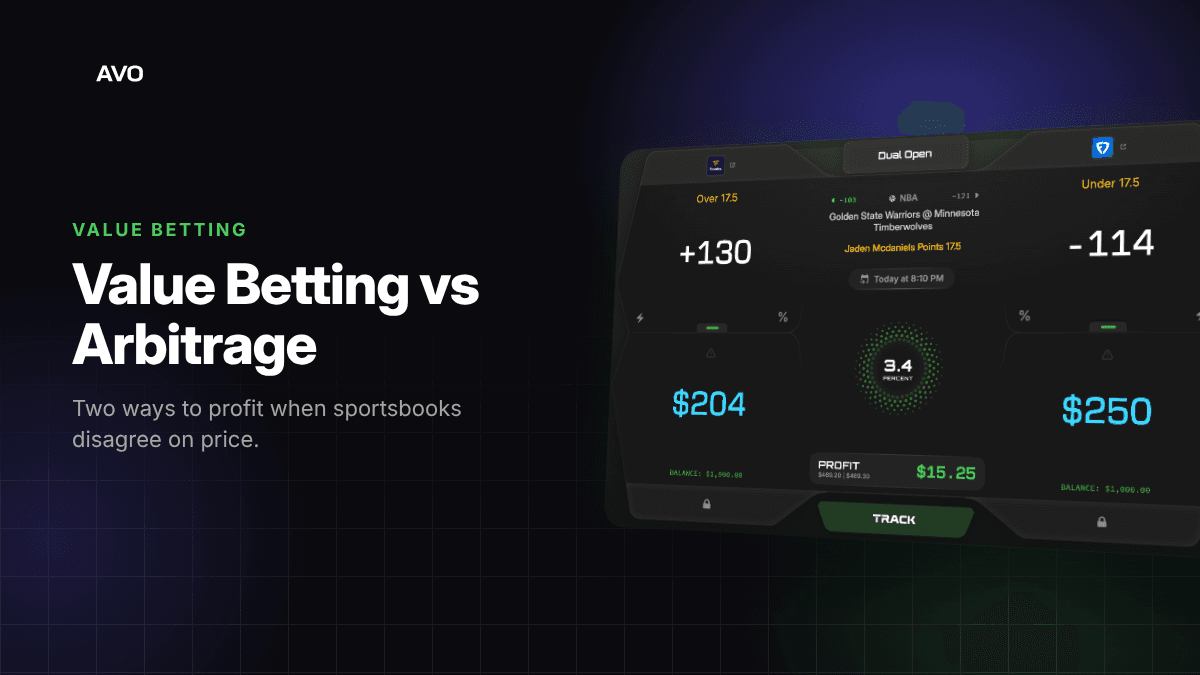
For value betting, AVO's +EV betting tool devigs sharp markets, compares every book against the fair price, and shows each value bet with its edge and a suggested stake. For arbitrage, the arbitrage betting tool finds price gaps across books, calculates exact stakes for each side, and lets you open both books at once with Dual Open so you can place both bets quickly.
Seeing both feeds in one place also makes it easy to mix the two strategies: arb when the locked-in profit is there, take value when the edge is bigger.
Try AVO Pro for 3 days for $1 →
Frequently Asked Questions
What is value betting in simple terms? It is betting only when the odds pay more than they should based on the true chance of the outcome. You will lose plenty of individual bets, but over many bets the extra payout works in your favor.
Is value betting the same as +EV betting? Yes. A value bet is a bet with positive expected value. The two terms describe the same idea, and many bettors use them interchangeably.
Is value betting better than arbitrage? Value betting usually earns more per dollar wagered, but it has much bigger swings. Arbitrage locks in a smaller profit on each event and feels steadier. Many bettors use both.
How do I know a bet is really value? Compare the odds with a fair price built from a sharp market with the vig removed. If the book pays more than that fair price, it is value. Beating the closing line over time is the best sign your fair prices are accurate.
How many bets does it take for value betting to work? There is no fixed number, but hundreds of bets is the minimum for results to start reflecting your edge. In the example above, about 1 in 10 bettors would still be down after 1,000 bets at a 5% edge.
Is arbitrage betting risk-free? Not quite. Lines can move before both bets are placed, books can void bets placed on clear pricing errors, and accounts that arb heavily often get limited. The idea behind it is covered on Wikipedia's arbitrage betting page.
AVO is an entertainment tool for adults and an analytics platform, not a sportsbook. AVO does not accept wagers and does not hold funds. You must be of legal age to bet in your jurisdiction (21+ in most states). Examples are illustrative, and betting involves real risk of loss. If you or someone you know has a gambling problem, call 1-800-GAMBLER. Please bet responsibly.

